Hexacorallia |
Scleractinia |
Lobophylliidae
Umwelt: Milieu / Klimazone / Tiefenbereich / Verbreitungsgebiet
Ökologie
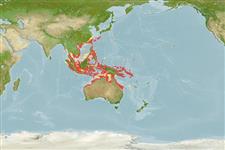
Riff-verbunden; tiefenbereich 0 - 40 m (Ref. 848). Tropical; 29°N - 24°S, 95°E - 165°E (Ref. 848)
Indo-West Pacific: Japan to Australia and Indonesia to Papua New Guinea.
Länge bei der ersten Reifung / Größe / Gewicht / Alter
Geschlechtsreife: Lm ? range ? - ? cm
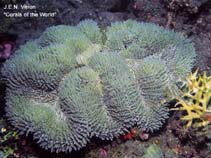
Formation: large, usually dome-shaped; flabello-meandroid with valleys closely compacted.; large colonies easily break apart despite a robust appearance. Polyps: with thick fleshy mantle hiding the skeletal structure. Mantle: covered by elongate papillae resembling tentacles; if touched, mantle retracts to reveal the underlying growth form, where valleys have no common walls. Color: uniform dark gray-brown. Underwater, it appears to be a Symphyllia (Ref. 848).
Occurs in most shallow reef environments (Ref. 848).
Lebenszyklus und Paarungsverhalten
Geschlechtsreife | Fortpflanzung | Ablaichen | Eier | Fruchtbarkeit | Larven
Members of the class Anthozoa are either gonochoric or hermaphroditic. Mature gametes are shed into the coelenteron and spawned through the mouth. Life cycle: The zygote develops into a planktonic planula larva. Metamorphosis begins with early morphogenesis of tentacles, septa and pharynx before larval settlement on the aboral end.
Veron, J.E.N. 2000 Corals of the world. Volume 3. Australian Institute of Marine Science and CRR Qld. Pty. Ltd. Australia. 490 p. (Ref. 848)
IUCN Rote Liste Status
(Ref. 130435: Version 2025-2 (Global))
CITES Status (Ref. 108899)
Not Evaluated
Bedrohung für Menschen
Nutzung durch Menschen
FAO - Publication: search | FishSource |
Tools
Mehr Information
Trophische ÖkologieLebensmittel (Beutetiere)
Nahrungszusammensetzung
Nahrungsaufnahme
Räuber
PopulationsdynamikWachstum
Max. Alter/Größen
Länge-Gewicht-Rel.
Länge-Länge-Verhältnis.
Längenhäufigkeiten
Massenkonvertierung
Dichte
LebenszyklusFortpflanzungGeschlechtsreifeFruchtbarkeitAblaichenEierEientwicklungLarven PhysiologieSauerstoffverbrauch
MenschenbezogenBriefmarken, Münzen, Verschiedenes.
Internet Quellen
Schätzungen auf der Grundlage von Modellen
Anfälligkeit der Fischerei
(Ref. 71543) |
(0 of 100). |
Preiskategorie
(Ref. 80766): |
Unknown. |