Hexacorallia |
Scleractinia |
Lobophylliidae
Entorno: milieu / zona climática / rango de profundidad / gama de distribución
Ecología
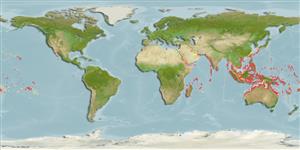
Asociado a arrecife; rango de profundidad 6 - 30 m (Referencia 8294). Tropical; 36°N - 29°S, 32°E - 110°W (Referencia 848)
Indo-Pacific: East Africa including Red Sea to Polynesia, north to Japan and south to Australia.
Longitud en la primera madurez / Tamaño / Peso / Edad
Madurez: Lm ? range ? - ? cm Max length : 5.0 cm WD macho / no sexado; (Referencia 269)
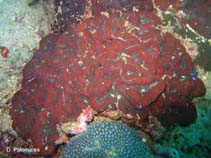
Formation: flat to hemispherical, may exceed 5 m across; phaceloid to flabello-meandroid with irregularly dividing valleys. Several colonies in different colors and polyp mantle textures may fuse to form a single composite stand. Septa: thickness taper from wall to columella, with tall sharp teeth. Polyps: thick and fleshy when retracted; mantles either smooth or rough. Color: uniform, or with 2 or more colors concentric to mouths or valley walls; corallites of the same colony share the same coloration (Ref. 848). This species is one of the two species of Lobophyllia and is similar to L. corymbosa, which is very similar to the first in overall growth form. The corallites are phaceloid, separated except at the base and form long meanders 1 to 5 cm in width. The septa and costae are covered with exsert, sharp dentations (Ref. 269).
Maximum depth from Ref. 100939. Occurs in upper reef slopes (Ref. 848). Zooxanthellae (Ref. 19). Has high bleaching level and high estimated mortality in Palau (Ref. 66144).
Ciclo vital y comportamiento de apareamiento
Madurez | Reproducción | Puesta | Huevos | Fecundidad | Larva
Hermaphroditic (Refs. 113708, 113712). Mature gametes are shed into the coelenteron and spawned through the mouth. Life cycle: The zygote develops into a planktonic planula larva. Metamorphosis begins with early morphogenesis of tentacles, septa and pharynx before larval settlement on the aboral end (Ref. 833).
Hodgson, G. 1998 Corals. p. 101-122. In Carpenter, K.E. and V.H. Niem (eds) FAO species identifidication guide for fishery purposes. The living marine resources of the Western Central Pacific. Vol. 1. Seaweeds, coral, bivalves and gastropods. FAO Rome. (Referencia 269)
Situación en la Lista Roja de la UICN
(Referencia 130435: Version 2025-2 (Global))
Estatus CITES (Referencia 108899)
CMS (Referencia 116361)
Not Evaluated
Amenaza para el ser humano
Usos humanos
FAO - Publication: search | FishSource |
Herramientas
Más información
Ecología TróficaAlimentos (presas)
Composición de la dieta
consumo de alimento
Despredadores
Dinámica de la poblaciónCrecimientoEdades / tallas máximasLongitud-peso rel.Longitud-longitud rel.Longitud-frecuenciasConversión de masasAbundancia FisiologíaConsumo del oxígeno
Relacionados con el ser humanoSellos, monedas, varios
Fuentes de Internet
Estimaciones basadas en modelos
Vulnerabilidad pesquera
(Referencia 71543) |
Low vulnerability (10 of 100). |
Categoría de precios
(Referencia 80766): |
Unknown. |