Hexacorallia |
Scleractinia |
Lobophylliidae
Milieu: milieu / Klimaatzone / Diepte / verspreidingsgebied
Ecologie
Rifbewoner; diepte 0 - 30 m (Ref. 848). Tropical; 22°N - 11°S, 77°E - 154°E (Ref. 848)
Indo-West Pacific: Sri Lanka to Papua New Guinea, north to Philippines, south to Lesser Sunda Islands, Indonesia.
Lengte bij maturiteit / Grootte / Gewicht / Leeftijd
Maturiteit: Lm ? range ? - ? cm
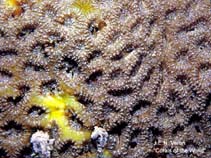
Formation: massive, cerioid, with circular corallites between 5 to 6 mm in diameter. Thick walls. Beaded septa. Poorly developed columellae. Thick fleshy tissue over the skeleton absent. Grooves and tubercle structure separating corallites may be present. In situ, can easily be mistaken for a faviid with small corallites. Color: pale gray (Ref. 848).
Occurs in shallow reef environments (Ref. 848).
Levenscyclus en paargedrag
Maturiteit | Voortplanting | Paaien | Eieren | Fecunditeit | Larven
Members of the class Anthozoa are either gonochoric or hermaphroditic. Mature gametes are shed into the coelenteron and spawned through the mouth. Life cycle: The zygote develops into a planktonic planula larva. Metamorphosis begins with early morphogenesis of tentacles, septa and pharynx before larval settlement on the aboral end.
Bisby, F.A., M.A. Ruggiero, K.L. Wilson, M. Cachuela-Palacio, S.W. Kimani, Y.R. Roskov, A. Soulier-Perkins and J. van Hertum 2005 Species 2000 & ITIS Catalogue of Life: 2005 Annual Checklist. CD-ROM; Species 2000: Reading, U.K. (Ref. 19)
Status op de Rode Lijst van het IUCN
(Ref. 130435: Version 2025-2 (Global))
CITES status (Ref. 108899)
Not Evaluated
Not Evaluated
Gevaar voor de mens
Gebruik door de mens
FAO - Publication: search | FishSource |
Tools
Meer informatie
Trofische ecologieVoedsel (prooien)
Dieetsamenstelling
Voedselconsumptie
Predatoren
PopulatiedynamicaGroei
Max. leeftijden / maten
Lengte-gewicht rel.
Lengte-lengte rel.
Lengtefrequenties
Massaconversie
Abundantie
LevenscyclusVoortplantingMaturiteitFecunditeitPaaienEierenOntwikkeling van de eierenLarven FysiologieZuurstofverbruik
Menselijk gerelateerdPostzegels, munten, diversen.
Internetbronnen
Schattingen op basis van modellen
Kwetsbaarheid van de visserij
(Ref. 71543) |
(0 of 100). |
Prijsklasse
(Ref. 80766): |
Unknown. |