Hexacorallia |
Scleractinia |
Faviidae
Umwelt: Milieu / Klimazone / Tiefenbereich / Verbreitungsgebiet
Ökologie
Sessile; tiefenbereich 0 - 58 m (Ref. 848). Subtropical; 33°N - 8°N, 98°W - 58°W (Ref. 848)
Western Atlantic: Gulf of Mexico, Caribbean Sea and Bermuda.
Länge bei der ersten Reifung / Größe / Gewicht / Alter
Geschlechtsreife: Lm ? range ? - ? cm
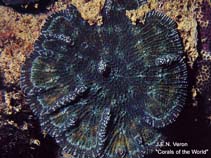
Formation: solid, rounded, often circular plates. Valleys: continuous, broad, shallow but sometimes deep; radiating from the original point of growth; with one row of mouths; short walls possible. Septo-costae possibly thinner than intervening spaces. Corallite centers: vaguely concentric to plate margins. Rudimentary or absent columellae. Color: often mottled gray or brown; also combinations of pink, green, and gray, with valleys and walls of contrasting colors (Ref. 848).
Maximum depth from Ref. 116012. Zooxanthellate (Ref. 116012). Occurs in most reef environments (Ref. 848).
Lebenszyklus und Paarungsverhalten
Geschlechtsreife | Fortpflanzung | Ablaichen | Eier | Fruchtbarkeit | Larven
Members of the class Anthozoa are either gonochoric or hermaphroditic. Mature gametes are shed into the coelenteron and spawned through the mouth. Life cycle: The zygote develops into a planktonic planula larva. Metamorphosis begins with early morphogenesis of tentacles, septa and pharynx before larval settlement on the aboral end.
Cairns, S.D., D.R. Calder, A. Brinckmann-Voss, C.B. Castro, D.G. Fautin, P.R. Pugh, C.E. Mills, W.C. Jaap, M.N. Arai, S.H.D. Haddock and D.M. Opresko 2003 Common and Scientific Names of Aquatic Invertebrates from the United States and Canada: Cnidaria and Ctenophore, Second Edition. American Fisheries Society Special Publication, no,28. XI+115. With CD-ROM. (Ref. 1663)
IUCN Rote Liste Status
(Ref. 130435: Version 2025-2 (Global))
CITES Status (Ref. 108899)
Not Evaluated
Bedrohung für Menschen
Nutzung durch Menschen
FAO - Publication: search | FishSource |
Tools
Mehr Information
Trophische ÖkologieLebensmittel (Beutetiere)
Nahrungszusammensetzung
Nahrungsaufnahme
Räuber
PopulationsdynamikWachstum
Max. Alter/Größen
Länge-Gewicht-Rel.
Länge-Länge-Verhältnis.
Längenhäufigkeiten
Massenkonvertierung
Dichte
LebenszyklusFortpflanzungGeschlechtsreifeFruchtbarkeitAblaichenEierEientwicklungLarven PhysiologieSauerstoffverbrauch
MenschenbezogenBriefmarken, Münzen, Verschiedenes.
Internet Quellen
Schätzungen auf der Grundlage von Modellen
Anfälligkeit der Fischerei
(Ref. 71543) |
(0 of 100). |
Preiskategorie
(Ref. 80766): |
Unknown. |