Hexacorallia |
Scleractinia |
Faviidae
Umwelt: Milieu / Klimazone / Tiefenbereich / Verbreitungsgebiet
Ökologie
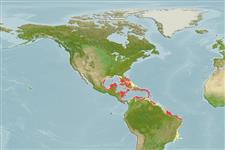
Riff-verbunden; tiefenbereich 0 - 80 m (Ref. 848). Tropical; 29°N - 25°S, 98°W - 31°W (Ref. 848)
Western Atlantic: Gulf of Mexico to Caribbean Sea. Southwest Atlantic: Brazil.
Länge bei der ersten Reifung / Größe / Gewicht / Alter
Geschlechtsreife: Lm ? range ? - ? cm
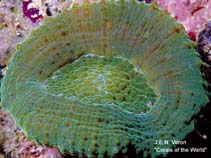
Usually attached, but may be free-living with a tapered base. Polyps: with one, rarely 2 or more, centers; may exceed 100 mm across but may be only a few millimeters thick, with tiers formed by successive regrowths. Several mouths may be present on corallites. Slightly different sizes of 2 to 3 orders of septa present. Paliform crown may be distinguished. Fleshy polyps. Color: uniform or variegated brown, red, tan, or green; sometimes bright orange but photographs brown (Ref. 848).
Maximum depth from Ref. 116012. Zooxanthellate (Ref. 116012). Occurs in lower reef slopes, soft substrates (Ref. 848) and hard substrate (Ref. 116012), occasionally on deep reefs and shaded walls (Ref. 415).
Lebenszyklus und Paarungsverhalten
Geschlechtsreife | Fortpflanzung | Ablaichen | Eier | Fruchtbarkeit | Larven
Members of the class Anthozoa are either gonochoric or hermaphroditic. Mature gametes are shed into the coelenteron and spawned through the mouth. Life cycle: The zygote develops into a planktonic planula larva. Metamorphosis begins with early morphogenesis of tentacles, septa and pharynx before larval settlement on the aboral end.
Collin, R., M.C. Díaz, J. Norenburg, R.M. Rocha, J.A. Sánchez, M. Schulze, A. Schwartz and A. Valdés 2005 Photographic identification guide to some common marine invertebrates of Bocas Del Toro, Panama. Caribbean Journal of Science. 41(3):638-707. (Ref. 415)
IUCN Rote Liste Status
(Ref. 130435: Version 2025-2 (Global))
CITES Status (Ref. 108899)
Not Evaluated
Bedrohung für Menschen
Nutzung durch Menschen
FAO - Publication: search | FishSource |
Tools
Mehr Information
Trophische ÖkologieLebensmittel (Beutetiere)
Nahrungszusammensetzung
Nahrungsaufnahme
Räuber
PopulationsdynamikWachstum
Max. Alter/Größen
Länge-Gewicht-Rel.
Länge-Länge-Verhältnis.
Längenhäufigkeiten
Massenkonvertierung
Dichte
LebenszyklusFortpflanzungGeschlechtsreifeFruchtbarkeitAblaichenEierEientwicklungLarven PhysiologieSauerstoffverbrauch
MenschenbezogenBriefmarken, Münzen, Verschiedenes.
Internet Quellen
Schätzungen auf der Grundlage von Modellen
Anfälligkeit der Fischerei
(Ref. 71543) |
(0 of 100). |
Preiskategorie
(Ref. 80766): |
Unknown. |