Hexacorallia |
Scleractinia |
Fungiidae
Environnement : milieu / zone climatique / profondeur / gamme de distribution
Écologie
Récifal; profondeur 0 - 40 m (Réf. 847). Tropical; 29°N - 27°S, 34°E - 172°W (Réf. 847)
Widely distributed throughout central Indo-Pacific.
Longueur à la première maturité / Taille / Poids / Âge
Maturité: Lm ? range ? - ? cm Max length : 60.0 cm WD mâle / non sexé; (Réf. 269)
Description synthétique
Morphologie
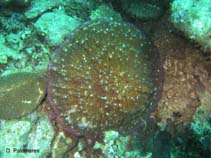
In situ, this species resembles an upside-down salad bowl, up to 60 cm in diameter and 1 to 1.5 cm thick. The septa generally run uninterrupted the entire distance from the primary corallite to the margin. Primary septa are much more exsert than secondaries, and both are strongly dentate. Corallites are irregularly distributed, but may form lines parallel to the margin. Each corallites is marked by a small mound of highly exsert septa, therefore the colony surface is rough. The underside is comparatively smooth with regulary exsert costae and low spines (Ref. 269). Zooxanthellae; free-living (Ref. 19).
In situ, this species resembles an upside-down salad bowl, up to 60 cm in diameter and 1 to 1.5 cm thick (Ref. 269). On middle to lower reef slopes away from wave action (Ref. 1943'>101943). Zooxanthellae; free-living (Ref. 19).
Cycle de vie et comportement reproducteur
Maturité | Reproduction | Frai | Œufs | Fécondité | Larves
Members of the class Anthozoa are either gonochoric or hermaphroditic. Mature gametes are shed into the coelenteron and spawned through the mouth. Life cycle: The zygote develops into a planktonic planula larva. Metamorphosis begins with early morphogenesis of tentacles, septa and pharynx before larval settlement on the aboral end.
Hodgson, G. 1998 Corals. p. 101-122. In Carpenter, K.E. and V.H. Niem (eds) FAO species identifidication guide for fishery purposes. The living marine resources of the Western Central Pacific. Vol. 1. Seaweeds, coral, bivalves and gastropods. FAO Rome. (Réf. 269)
Statut dans la liste rouge de l'IUCN
(Réf. 130435: Version 2025-2 (Global))
statut CITES (Réf. 108899)
Not Evaluated
Menace pour l'homme
Utilisations par l'homme
FAO - Publication: search | FishSource |
Outils
Plus d'informations
Écologie trophiqueAliments (proies)
Composition du régime alimentaire
Consommation alimentaire
Prédateurs
Dynamique des populationsCroissance
Âges / tailles maximales
Longueur-poids rel.
Rel. longueur-longueur.
Fréquences de longueurs
Conversion de masse
Abondance
Cycle de vieReproductionMaturitéFéconditéFraiŒufsDéveloppement de l'œufLarves PhysiologieConsommation d'oxygène
Liées à l'hommeTimbres, pièces de monnaie, divers
Sources Internet
Estimations basées sur des modèles
Vulnérabilité de la pêche
(Réf. 71543) |
Moderate vulnerability (44 of 100). |
Catégorie de prix
(Réf. 80766): |
Unknown. |