Hexacorallia |
Scleractinia |
Agariciidae
Miljö: miljö / Klimatzon / djupintervall / distributionsområde
Ekologi
Revassocierade; djupintervall 0 - 102 m (Ref. 847). Tropical; 33°N - 25°S, 98°W - 31°W (Ref. 847)
Western Atlantic: Throughout the Caribbean; south to Brazil.
Längd vid första mognad / Storlek / Vikt / Ålder
Könsmognad: Lm ? range ? - ? cm
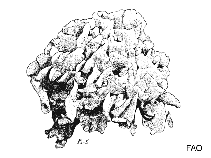
Colonies form flat, unifacial explanate plates with corallites in long, roughly concentric valley. Valleys are closely (2-4mm) spaced. Corallites are small, closed-together and faced forwards. Columellae are weakly developed. Grey, grey-brown or green in color.
Maximum depth from Ref. 83917. Zooxanthellate (Ref. 116012).
Livscykel och parningsbeteende
Könsmognad | Reproduktion | Lek | Ägg | Fekunditet | Larver
Members of the class Anthozoa are either gonochoric or hermaphroditic. Mature gametes are shed into the coelenteron and spawned through the mouth. Life cycle: The zygote develops into a planktonic planula larva. Metamorphosis begins with early morphogenesis of tentacles, septa and pharynx before larval settlement on the aboral end (Ref. 833).
Collin, R., M.C. Díaz, J. Norenburg, R.M. Rocha, J.A. Sánchez, M. Schulze, A. Schwartz and A. Valdés 2005 Photographic identification guide to some common marine invertebrates of Bocas Del Toro, Panama. Caribbean Journal of Science. 41(3):638-707. (Ref. 415)
Status på IUCN:s rödlista
(Ref. 130435: Version 2025-2 (Global))
CITES-status (Ref. 108899)
Not Evaluated
Hot mot människor
Mänskliga användningsområden
FAO - Publication: search | FishSource |
Verktyg
Ytterligare information
Trofisk ekologiLivsmedelsartiklar (preys)
Födosammansättning
Födointag
Predatorer
PopulationsdynamikTillväxt
Max. åldrar / storlekar
Längd-vikt rel.
Längd-längd rel.
Längd-frekvenser
Massakonvertering
Abundans
MänniskorelateradFrimärken, mynt, diverse.
Internet-källor
Uppskattningar baserade på modeller
Sårbarhet i fisket
(Ref. 71543) |
(0 of 100). |
Priskategori
(Ref. 80766): |
Unknown. |