Hexacorallia |
Scleractinia |
Caryophylliidae
Environnement : milieu / zone climatique / profondeur / gamme de distribution
Écologie
Récifal. Subtropical
Eastern Atlantic and the Mediterranean.
Longueur à la première maturité / Taille / Poids / Âge
Maturité: Lm ? range ? - ? cm
Description synthétique
Morphologie
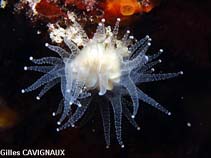
The stony coral are not colonial. Vertical size skeleton reaches 0.25 mm, its section is round; at base not narrowed in normal conditions. End of the tentacles forming a small spherical bludgeon brown; white or pink polyps (Ref. 358).
Vertical skeleton size: 0.25 cm (Ref. 358). Habitat: Interior of underwater caves and anfractuosities, lower level of rock overhangs, bottom and walls of rock nature little exposed to the light species present of the small funds until greater depth (Ref. 358). Known from infra- and circalittoral zones (Ref. 85338).
Cycle de vie et comportement reproducteur
Maturité | Reproduction | Frai | Œufs | Fécondité | Larves
Members of the class Anthozoa are either gonochoric or hermaphroditic. Mature gametes are shed into the coelenteron and spawned through the mouth. Life cycle: The zygote develops into a planktonic planula larva. Metamorphosis begins with early morphogenesis of tentacles, septa and pharynx before larval settlement on the aboral end.
Göthel, H. 1992 Guide de la faune sous-marine: La Méditerranée. Invertébrés marins et poissons. Eygen Ulmer GmbH & Co. 318 p. (Réf. 358)
Statut dans la liste rouge de l'IUCN
(Réf. 130435: Version 2025-2 (Global))
statut CITES (Réf. 108899)
Not Evaluated
Menace pour l'homme
Utilisations par l'homme
FAO - Publication: search | FishSource |
Outils
Plus d'informations
Écologie trophiqueAliments (proies)
Composition du régime alimentaire
Consommation alimentaire
Prédateurs
Dynamique des populationsCroissanceÂges / tailles maximalesLongueur-poids rel.Rel. longueur-longueur.Fréquences de longueursConversion de masseAbondance Cycle de vieReproductionMaturitéFéconditéFraiŒufsDéveloppement de l'œufLarves PhysiologieConsommation d'oxygène
Liées à l'hommeTimbres, pièces de monnaie, divers
Sources Internet
Estimations basées sur des modèles
Vulnérabilité de la pêche
(Réf. 71543) |
(0 of 100). |
Catégorie de prix
(Réf. 80766): |
Unknown. |