Hexacorallia |
Scleractinia |
Caryophylliidae
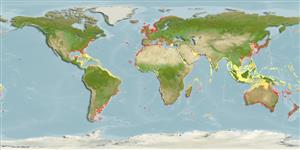
Environnement : milieu / zone climatique / profondeur / gamme de distribution
Écologie
Récifal. Subtropical
Atlantic Ocean, the Mediterranean and Indo-West Pacific.
Longueur à la première maturité / Taille / Poids / Âge
Maturité: Lm ? range ? - ? cm
Description synthétique
Morphologie
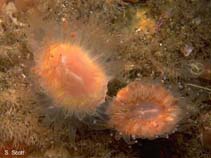
The stony corals non colonial, whose skeleton limestone reaches 0.35 cm vertically, of oval section, at base little, even hardly narrowed. The tentacles comprise at their end a small spherical bludgeon. Polyps: brownish coupler, brownish or pink, the generally ringed oral disc of a brown ring, drawing towards the red (Ref. 358).
Epibenthic (Ref. 87524). Polyps establish in excavations and cracks, at lower levels of rock overhangs and on rock faces, at depths greater than 10 m; seldom in shallow waters (Ref. 358). Occurs along the infralittoral, circalittoral and bathyal zones (Ref. 85338). Found throughout the Mediterranean. Associated with the barnacle Pyrgoma anglicum, as symphoriontes (Ref. 358).
Cycle de vie et comportement reproducteur
Maturité | Reproduction | Frai | Œufs | Fécondité | Larves
This species is viviparous, the fecundation of the ovum taking place inside the body of the parent, where they develop to with it until the stage of polyps in miniature (Ref. 358).
Göthel, H. 1992 Guide de la faune sous-marine: La Méditerranée. Invertébrés marins et poissons. Eygen Ulmer GmbH & Co. 318 p. (Réf. 358)
Statut dans la liste rouge de l'IUCN
(Réf. 130435: Version 2025-2 (Global))
statut CITES (Réf. 108899)
Not Evaluated
Menace pour l'homme
Utilisations par l'homme
FAO - Publication: search | FishSource |
Outils
Plus d'informations
Écologie trophiqueAliments (proies)
Composition du régime alimentaire
Consommation alimentaire
Prédateurs
Dynamique des populationsCroissance
Âges / tailles maximales
Longueur-poids rel.
Rel. longueur-longueur.
Fréquences de longueurs
Conversion de masse
Abondance
Cycle de vieReproductionMaturitéFéconditéFraiŒufsDéveloppement de l'œufLarves PhysiologieConsommation d'oxygène
Liées à l'hommeTimbres, pièces de monnaie, divers
Sources Internet
Estimations basées sur des modèles
Vulnérabilité de la pêche
(Réf. 71543) |
(0 of 100). |
Catégorie de prix
(Réf. 80766): |
Unknown. |