Hexacorallia |
Scleractinia |
Merulinidae
Umwelt: Milieu / Klimazone / Tiefenbereich / Verbreitungsgebiet
Ökologie
Riff-verbunden; tiefenbereich 6 - 30 m (Ref. 115199). Tropical; 36°N - 34°S, 26°E - 137°W (Ref. 848)
Indo-Pacific. Tropical to subtropical.
Länge bei der ersten Reifung / Größe / Gewicht / Alter
Geschlechtsreife: Lm ? range ? - ? cm
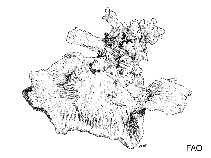
Colony: massive. Corallites: circular, closely compacted in shallow water, more widely spaced in deeper water. Septa: widely spaced, distinctly irregular. Often poorly developed paliform lobes. Color: pale yellow, cream or green, with dark brown or green oral discs (Ref. 848).
Minimum depth from Ref. 104515. Found in all reef environments, often a dominant species of back reef margins (Ref. 848). Also on subtidal rock, rocky reefs, outer reef channel, back and foreslope and lagoons; occasionally in inter-reef soft substrate (Ref. 98471). Tends to form low heads or encrust rocks in shallow waters (Ref. 130769).
Lebenszyklus und Paarungsverhalten
Geschlechtsreife | Fortpflanzung | Ablaichen | Eier | Fruchtbarkeit | Larven
Hermaphroditic (Ref. 113712). Mature gametes are shed into the coelenteron and spawned through the mouth. Life cycle: The zygote develops into a planktonic planula larva. Metamorphosis begins with early morphogenesis of tentacles, septa and pharynx before larval settlement on the aboral end (Ref. 833).
Ross, M.A. and G. Hodgson 1981 A quantitative study of hermatypic coral diversity and zonation at Apo Reef, Mindiro, Philippines. Proceedings of the Fourth International Coral Reef Syposium, Manila 2:281-291. (Ref. 8294)
IUCN Rote Liste Status
(Ref. 130435: Version 2025-2 (Global))
CITES Status (Ref. 108899)
Not Evaluated
Bedrohung für Menschen
Nutzung durch Menschen
FAO - Publication: search | FishSource |
Tools
Mehr Information
Trophische ÖkologieLebensmittel (Beutetiere)
Nahrungszusammensetzung
Nahrungsaufnahme
Räuber
PopulationsdynamikWachstumMax. Alter/GrößenLänge-Gewicht-Rel.Länge-Länge-Verhältnis.LängenhäufigkeitenMassenkonvertierungDichte PhysiologieSauerstoffverbrauch
MenschenbezogenBriefmarken, Münzen, Verschiedenes.
Internet Quellen
Schätzungen auf der Grundlage von Modellen
Anfälligkeit der Fischerei
(Ref. 71543) |
(0 of 100). |
Preiskategorie
(Ref. 80766): |
Unknown. |