Bivalvia |
Cardiida |
Cardiidae
Umwelt: Milieu / Klimazone / Tiefenbereich / Verbreitungsgebiet
Ökologie
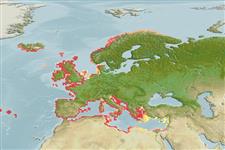
Benthic; tiefenbereich 5 - 30 m (Ref. 2758). Temperate; 54°N - 30°N, 26°W - 36°E
Northeast Atlantic and the Mediterranean: from Celtic and Lusitanian provinces, extending into the Mediterranean.
Länge bei der ersten Reifung / Größe / Gewicht / Alter
Geschlechtsreife: Lm ? range ? - ? cm Max length : 10.2 cm SHL Männchen/unbestimmt; (Ref. 360); common length : 7.6 cm SHL Männchen/unbestimmt; (Ref. 360)
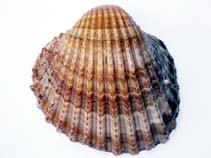
Shell: solid, convex valves, equivalve and inequilateral, roughly oval in shape, uniformly deep yellow brown in color; sculpture consists of 20-22 well-developed ribs, with triangular spikes along the mid-line, in between are very marked concentric grooves; external ligament behind the umbones, hinge is heterodont; inside the valves are two identical scars (dimyarian and isomyarian) joined by a continuous pallial line, lacking a sinus. Body: foot is roughly cylindrical, well developed and used for leaping on the sand; distal extremity is bright red.
Minimum depth from Ref. 2703. Maximum depth from Ref. 106644. Found in an estuary (Ref. 122134). Coastal species (Ref. 112064), intertidal to the continental shelf (Ref. 105964). Lives in mud (Ref. 105964) and coarse sand (Ref. 106644).
Lebenszyklus und Paarungsverhalten
Geschlechtsreife | Fortpflanzung | Ablaichen | Eier | Fruchtbarkeit | Larven
Members of the class Bivalvia are mostly gonochoric, some are protandric hermaphrodites. Life cycle: Embryos develop into free-swimming trocophore larvae, succeeded by the bivalve veliger, resembling a miniature clam.
Gaspar, M.B., M.N. Santos and P. Vasconcelos 2001 Weight-length relationships of 25 bivalve species (Mollusca: Bivalvia) from the Algarve coast (southern Portugal). J. Mar. Biol. Ass. U.K. 81:805-807. (Ref. 2758)
IUCN Rote Liste Status
(Ref. 130435: Version 2025-2 (Global))
CITES Status (Ref. 108899)
Not Evaluated
Not Evaluated
Bedrohung für Menschen
Nutzung durch Menschen
Fischereien: kommerziell
FAO - Publication: search | FishSource |
Tools
Mehr Information
Trophische ÖkologieLebensmittel (Beutetiere)
Nahrungszusammensetzung
Nahrungsaufnahme
Räuber
LebenszyklusFortpflanzungGeschlechtsreifeFruchtbarkeitAblaichenEierEientwicklungLarven PhysiologieSauerstoffverbrauch
Internet Quellen
Schätzungen auf der Grundlage von Modellen
Anfälligkeit der Fischerei
(Ref. 71543) |
Low vulnerability (10 of 100). |
Preiskategorie
(Ref. 80766): |
Low. |