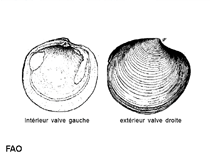
Bivalvia |
Lucinida |
Lucinidae
Miljö: miljö / Klimatzon / djupintervall / distributionsområde
Ekologi
Benthic; djupintervall ? - 500 m (Ref. 124714). Temperate; 72°N - 17°N, 11°W - 25°E
Eastern Atlantic and the Mediterranean Sea: from Norway to Ireland, south to Mauritania and east to Greece. Temperate and subtropical.
Längd vid första mognad / Storlek / Vikt / Ålder
Könsmognad: Lm ? range ? - ? cm
Inhabit sandbanks and muddy bottoms associated with rich organic sediment. A microvore that feeds on organic detritus (Ref. 96352).
Livscykel och parningsbeteende
Könsmognad | Reproduktion | Lek | Ägg | Fekunditet | Larver
Members of the class Bivalvia are mostly gonochoric, some are protandric hermaphrodites. Life cycle: Embryos develop into free-swimming trocophore larvae, succeeded by the bivalve veliger, resembling a miniature clam.
The British Flora and Fauna Database 2007 The British Flora and Fauna Database. http://www.british-towns.net/nature_menu.asp (Ref. 8593)
Status på IUCN:s rödlista
(Ref. 130435: Version 2025-2 (Global))
CITES-status (Ref. 108899)
Not Evaluated
Not Evaluated
Hot mot människor
Mänskliga användningsområden
FAO - Publication: search | FishSource |
Verktyg
Ytterligare information
LivscykelReproduktionKönsmognadFekunditetLekÄggUtveckling av äggLarver MänniskorelateradFrimärken, mynt, diverse.
Internet-källor
Uppskattningar baserade på modeller
Sårbarhet i fisket
(Ref. 71543) |
(0 of 100). |
Priskategori
(Ref. 80766): |
Unknown. |