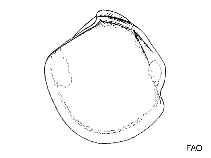
Bivalvia |
Lucinida |
Thyasiridae
Environnement : milieu / zone climatique / profondeur / gamme de distribution
Écologie
Benthic; saumâtre; profondeur 32 - 250 m (Réf. 95344). Temperate; 85°N - 15°S, 142°E - 66°E
Arctic, Pacific Ocean, Atlantic Ocean and the Mediterranean. Polar to subtropical.
Longueur à la première maturité / Taille / Poids / Âge
Maturité: Lm ? range ? - ? cm Max length : 1.2 cm SHL mâle / non sexé; (Réf. 95344)
Minimum depth from Ref. 125485. Found in estuarine and inshore areas, in mud, silt, and fine sand substrate. Associated with rich organic sediment. A microvore that feeds on organic detritus (Ref. 96352).
Cycle de vie et comportement reproducteur
Maturité | Reproduction | Frai | Œufs | Fécondité | Larves
Members of the class Bivalvia are mostly gonochoric, some are protandric hermaphrodites. Life cycle: Embryos develop into free-swimming trocophore larvae, succeeded by the bivalve veliger, resembling a miniature clam.
Bisby, F.A., M.A. Ruggiero, K.L. Wilson, M. Cachuela-Palacio, S.W. Kimani, Y.R. Roskov, A. Soulier-Perkins and J. van Hertum 2005 Species 2000 & ITIS Catalogue of Life: 2005 Annual Checklist. CD-ROM; Species 2000: Reading, U.K. (Réf. 19)
Statut dans la liste rouge de l'IUCN
(Réf. 130435: Version 2025-2 (Global))
statut CITES (Réf. 108899)
Not Evaluated
Not Evaluated
Menace pour l'homme
Utilisations par l'homme
FAO - Publication: search | FishSource |
Outils
Plus d'informations
Dynamique des populations Cycle de vieReproductionMaturitéFéconditéFraiŒufsDéveloppement de l'œufLarves PhysiologieConsommation d'oxygène
Liées à l'hommeTimbres, pièces de monnaie, divers
Sources Internet
Estimations basées sur des modèles
Vulnérabilité de la pêche
(Réf. 71543) |
Low vulnerability (10 of 100). |
Catégorie de prix
(Réf. 80766): |
Unknown. |