Bivalvia |
Cardiida |
Solecurtidae
Environnement : milieu / zone climatique / profondeur / gamme de distribution
Écologie
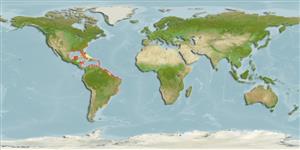
Benthic; saumâtre; profondeur 0 - 24 m (Réf. 83435). Tropical; 43°N - 43°S, 98°W - 34°W
Western Atlantic: from Cape Cod to Argentinian Patagonia, and Gulf of Mexico, 42°N, USA to 41°S, San Matias Gulf, Argentina.
Longueur à la première maturité / Taille / Poids / Âge
Maturité: Lm ? range ? - ? cm Max length : 11.9 cm SHL mâle / non sexé; (Réf. 83435); common length : 8.0 cm SHL mâle / non sexé; (Réf. 344)
Description synthétique
Morphologie
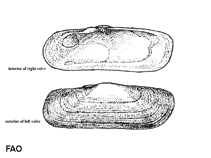
Shell light, elongate, semi-cylindrical, inflated, posterior margin rounded, anterior margin straight but oblique. Weak radial ridge present posteriorly. Surface smooth except for fine concentric lines. Umbones slightly removed from centre of shell in posterior direction, indistinct. Colour: periostracum olive green to brownish yellow.
Maximum depth from Ref. 104454. Intertidal to shallow subtidal, in muddy sand or mud (Ref 344). Inhabits stable sediments with silts and clays and are covered with film of benthic microalgae (Ref. 104234). Also occurs in estuaries. Suspension feeder (Refs. 104108, 104234). Builds permanent passageways from 50 to 70 cm deep (Ref. 104108).
Cycle de vie et comportement reproducteur
Maturité | Reproduction | Frai | Œufs | Fécondité | Larves
Members of the class Bivalvia are mostly gonochoric (Ref. 833), some are protandric hermaphrodites (Ref. 104221). Life cycle: Embryos develop into free-swimming trocophore larvae, succeeded by the bivalve veliger, resembling a miniature clam.
Leal, J.H. 2003 Bivalves. p. 25-98. In Carpenter, K.E. (ed.). The living marine resources of the Western Central Atlantic. Volume 1: Introduction, molluscs, crustaceans, hagfishes, sharks, batoid fishes, and chimaeras. FAO Species Identification Guide for Fishery Purposes and American Society of Ichthyologists and Herpetologists Special Publication No. 5. 1600p. (Réf. 344)
Statut dans la liste rouge de l'IUCN
(Réf. 130435: Version 2025-2 (Global))
statut CITES (Réf. 108899)
Not Evaluated
Not Evaluated
Menace pour l'homme
Utilisations par l'homme
Pêcheries: commercial; Aquaculture: probable utilisation future; appât: occasionally
FAO - Publication: search | FishSource |
Outils
Plus d'informations
Dynamique des populations PhysiologieConsommation d'oxygène
Liées à l'hommeTimbres, pièces de monnaie, divers
Sources Internet
Estimations basées sur des modèles
Vulnérabilité de la pêche
(Réf. 71543) |
Low vulnerability (21 of 100). |
Catégorie de prix
(Réf. 80766): |
Unknown. |