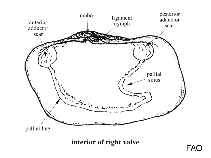
Bivalvia |
Adapedonta |
Hiatellidae
Environnement : milieu / zone climatique / profondeur / gamme de distribution
Écologie
Benthic; profondeur 0 - 110 m (Réf. 865). Temperate; 61°N - 26°N, 146°W - 112°W (Réf. 104413)
Eastern Pacific: From Alaska to Baja California. Subtropical to temperate.
Longueur à la première maturité / Taille / Poids / Âge
Maturité: Lm ? range ? - ? cm Max length : 17.5 cm SHL mâle / non sexé; (Réf. 865); âge max. reporté: 100 années (Réf. 8702)
Maximum depth based on occurrence record (Ref. 105142); to be replaced with a better reference. It is found on sandy and muddy bottoms, in low intertidal areas to a depth of 15 meters (Ref. 865). Subtidal populations aggregate in dense beds to a depth of 110 m (Ref. 105142). Adults bury up to 1 m (Ref. 105154). Juveniles are preyed upon by fish, starfish, crabs, and snails (Ref. 105142).
Cycle de vie et comportement reproducteur
Maturité | Reproduction | Frai | Œufs | Fécondité | Larves
Members of the class Bivalvia are mostly gonochoric, some are protandric hermaphrodites. Life cycle: Embryos develop into free-swimming trocophore larvae, succeeded by the bivalve veliger, resembling a miniature clam.
Pacific Northwest Shell Club 2014 Pacific Northwest marine molluscan biodiversity. Pacific Northwest Shell Club, www.PNWCS.org. http://www.bily.com/pnwsc/web-content/Northwest%20Marine%20Molluscan%20Biodiversity.html [Accessed 06/02/2014]. (Réf. 94906)
Statut dans la liste rouge de l'IUCN
(Réf. 130435: Version 2025-2 (Global))
statut CITES (Réf. 108899)
Not Evaluated
Not Evaluated
Menace pour l'homme
Utilisations par l'homme
Pêcheries: commercial
FAO - Publication: search | FishSource |
Outils
Plus d'informations
Dynamique des populations Cycle de vieReproductionMaturitéFéconditéFraiŒufsDéveloppement de l'œufLarves PhysiologieConsommation d'oxygène
Liées à l'hommeTimbres, pièces de monnaie, divers
Sources Internet
Estimations basées sur des modèles
Vulnérabilité de la pêche
(Réf. 71543) |
High vulnerability (58 of 100). |
Catégorie de prix
(Réf. 80766): |
Unknown. |