Bivalvia |
Myida |
Teredinidae
Environnement : milieu / zone climatique / profondeur / gamme de distribution
Écologie
Benthic; saumâtre; profondeur 0 - 150 m (Réf. 76971), usually 0 - 20 m (Réf. 75831). Temperate; 11°C - 25°C (Réf. 98650); 54°N - 16°N, 105°E - 143°E
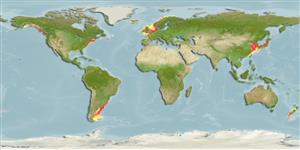
Northwest Pacific: Sakhalin Islands, Russia south to Xisha Islands, China. Introduced in the Atlantic, Baltic Sea and the Mediterranean. Temperate to tropical.
Longueur à la première maturité / Taille / Poids / Âge
Maturité: Lm ? range ? - ? cm Max length : 50.0 cm TL mâle / non sexé; (Réf. 76971)
Description synthétique
Morphologie
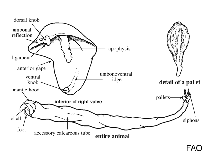
Body reddish and with a characteristic elongate worm-like shape. Anterior part covered by a small (up to 2 cm long) reduced helmet-like shell consisting of two triangular-shaped parts (anterior and posterior lobes similar), which is white with light brown periostracum (outermost layer). This shell acts as a wood-boring instrument. The brownish soft worm-like body lies in a calcareous tube up to 60 cm long and 1 cm in diameter.
Inhabits wooden material (logs, pilings, ships, other submerged wooden constructions) from temperate to tropical zones (Ref. 76974). Salinity tolerance: 5-35 parts per mille (Ref. 78117). Considered a pest and an invasive species as it destroys submerged wood (Ref. 76971). Found in intertidal areas in timber (Ref. 75831). Wood borer (Ref. 104365).
Cycle de vie et comportement reproducteur
Maturité | Reproduction | Frai | Œufs | Fécondité | Larves
Female phase: 8-10 weeks after larval stage; females larviparous, i.e., deposits living larvae instead of eggs; fertilized eggs develop through half of the larval period in the maternal gill chambers. Primary male phase: after 4-6 weeks of larval stage in warm temperatures, up to 6 months in colder temperatures with total length range 2-3 cm and 0.2 body diameter (Ref. 78112). It displays poecilogonony as its reproductive strategy (Ref. 99837).
Harms, J. 1993 Check list of species (algae, invertebrates and vertebrates) found in the vicinity of the island of Helgoland (North Sea, German Bight) - a review of recent records. Helgoländer Meeresunters 47:1-34. (Réf. 2711)
Statut dans la liste rouge de l'IUCN
(Réf. 130435: Version 2025-2 (Global))
statut CITES (Réf. 108899)
Not Evaluated
Not Evaluated
Menace pour l'homme
Potential pest
Utilisations par l'homme
Pêcheries: sans intérêt
FAO - Publication: search | FishSource |
Outils
Plus d'informations
Écologie trophiqueAliments (proies)
Composition du régime alimentaire
Consommation alimentaire
Prédateurs
Dynamique des populations PhysiologieConsommation d'oxygène
Liées à l'hommeTimbres, pièces de monnaie, divers
Sources Internet
Estimations basées sur des modèles
Vulnérabilité de la pêche
(Réf. 71543) |
Moderate vulnerability (40 of 100). |
Catégorie de prix
(Réf. 80766): |
Unknown. |