Ophiuroidea |
Euryalida |
Gorgonocephalidae
Umwelt: Milieu / Klimazone / Tiefenbereich / Verbreitungsgebiet
Ökologie
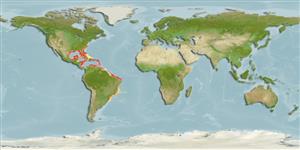
Riff-verbunden; tiefenbereich 2 - 500 m (Ref. 111335). Tropical; 38°N - 35°S, 100°W - 28°W
Western Atlantic: From North Carolina to Belize, Costa Rica and Panama; throughout the Caribbean and south to Rio Grande do Norte, Brazil.
Länge bei der ersten Reifung / Größe / Gewicht / Alter
Geschlechtsreife: Lm ? range ? - ? cm Max length : 7.0 cm WD Männchen/unbestimmt; (Ref. )
Maximum length measurement used is central disk diameter. Minimum depth from Ref. 83942. This is a subtidal species found on rocky and sandy bottoms and in coral reefs at depths of 2 to 70 m (Ref. 83942).
Lebenszyklus und Paarungsverhalten
Geschlechtsreife | Fortpflanzung | Ablaichen | Eier | Fruchtbarkeit | Larven
Members of the class Ophiuroidea are mostly gonochoric, others are protandric. Fertilization is external. Brooding is common, bursae is used as brood chambers where the embryos develop into juveniles and later crawl out from the bursal slits. Life cycle: Embryos hatch into free-swimming planktotrophic larvae and later metamorphose into tiny brittle stars which sink down the bottom where they grow into adult form.
Collin, R., M.C. Díaz, J. Norenburg, R.M. Rocha, J.A. Sánchez, M. Schulze, A. Schwartz and A. Valdés 2005 Photographic identification guide to some common marine invertebrates of Bocas Del Toro, Panama. Caribbean Journal of Science. 41(3):638-707. (Ref. 415)
IUCN Rote Liste Status
(Ref. 130435: Version 2025-2 (Global))
CITES Status (Ref. 108899)
Not Evaluated
Not Evaluated
Bedrohung für Menschen
Nutzung durch Menschen
Fischereien: kommerziell
FAO - Publication: search | FishSource |
Tools
Mehr Information
PopulationsdynamikWachstum
Max. Alter/Größen
Länge-Gewicht-Rel.
Länge-Länge-Verhältnis.
Längenhäufigkeiten
Massenkonvertierung
Dichte
LebenszyklusFortpflanzungGeschlechtsreifeFruchtbarkeitAblaichenEierEientwicklungLarven PhysiologieSauerstoffverbrauch
MenschenbezogenBriefmarken, Münzen, Verschiedenes.
Internet Quellen
Schätzungen auf der Grundlage von Modellen
Anfälligkeit der Fischerei
(Ref. 71543) |
Low vulnerability (10 of 100). |
Preiskategorie
(Ref. 80766): |
Unknown. |