Holothuroidea |
Holothuriida |
Holothuriidae
Environnement : milieu / zone climatique / profondeur / gamme de distribution
Écologie
Récifal; profondeur 0 - 30 m (Réf. 85345). Tropical
Cosmopolitan.
Longueur à la première maturité / Taille / Poids / Âge
Maturité: Lm ? range ? - ? cm Max length : 30.0 cm TL mâle / non sexé; (Réf. 85218)
Description synthétique
Morphologie
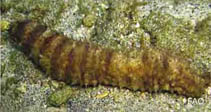
Elongated cylindrical body shape, with the end being usually thinner. Body is grayish-brown or brown, with grey or brown bands on the back. Papillae on the back are promiment, making the species appear rough.
During the day, this species lives under coralline rubble and in crevices on reef flats and forereef slopes (Ref. 85218); and is often found in sand and grassy areas (Ref. 86832). At night it feeds by extending its anterior end from the crevice (Ref. 85218). Deposit feeder (Refs. 108117, 116259). Releases a sticky white substance called Cuvierian tubules when stressed (Ref. 125532). Found in waters less than 30m. Associated with coral communities (Ref. 129602).
Cycle de vie et comportement reproducteur
Maturité | Reproduction | Frai | Œufs | Fécondité | Larves
Spawning occurs in spring.
James, D.B. 2001 Twenty sea cucumbers from seas around India. Naga, ICLARM Q. 24(1-2):4-8. (Réf. 118)
Statut dans la liste rouge de l'IUCN
(Réf. 130435: Version 2025-2 (Global))
statut CITES (Réf. 108899)
Not Evaluated
Not Evaluated
Menace pour l'homme
Utilisations par l'homme
FAO - Publication: search | FishSource |
Outils
Plus d'informations
Dynamique des populationsCroissanceÂges / tailles maximalesLongueur-poids rel.Rel. longueur-longueur.Fréquences de longueursConversion de masseAbondance Cycle de vieReproductionMaturitéFéconditéFraiŒufsDéveloppement de l'œufLarves PhysiologieConsommation d'oxygène
Liées à l'hommeTimbres, pièces de monnaie, divers
Sources Internet
Estimations basées sur des modèles
Vulnérabilité de la pêche
(Réf. 71543) |
Low vulnerability (20 of 100). |
Catégorie de prix
(Réf. 80766): |
Unknown. |