Gastropoda |
Neogastropoda |
Muricidae
Umwelt: Milieu / Klimazone / Tiefenbereich / Verbreitungsgebiet
Ökologie
Benthic; tiefenbereich 0 - 60 m (Ref. 95344). Subtropical
Eastern Pacific and the Arctic: Alaska to California. Subtropical to boreal.
Länge bei der ersten Reifung / Größe / Gewicht / Alter
Geschlechtsreife: Lm ? range ? - ? cm Max length : 9.0 cm SHL Männchen/unbestimmt; (Ref. 865); common length : 8.0 cm SHL Männchen/unbestimmt; (Ref. 312)
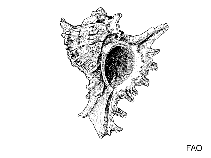
Description: Shell has spiral ridges. Has at least three prominent wing-like structures, worn off in older snails. Color is brown and white to creamy-white. Young snails have tooth-like projections on the lip of the shell (Ref. 312).
Occurs in the low intertidal zone. Uses the radula to bore through the calcareous shells of its prey (clams, mussels, and barnacles; Ref. 312) (Ref. 312).
Lebenszyklus und Paarungsverhalten
Geschlechtsreife | Fortpflanzung | Ablaichen | Eier | Fruchtbarkeit | Larven
This species is a non-broadcast spawner. Life cycle does not include trocophore stage. Also Ref. 833.
Gallivan, G. and J. Danforth 1999 Phylum Mollusca. Marine Science Institute. (Ref. 312)
IUCN Rote Liste Status
(Ref. 130435: Version 2025-2 (Global))
CITES Status (Ref. 108899)
Not Evaluated
Not Evaluated
Bedrohung für Menschen
Nutzung durch Menschen
FAO - Publication: search | FishSource |
Tools
Mehr Information
PopulationsdynamikWachstum
Max. Alter/Größen
Länge-Gewicht-Rel.
Länge-Länge-Verhältnis.
Längenhäufigkeiten
Massenkonvertierung
Dichte
PhysiologieSauerstoffverbrauch
MenschenbezogenBriefmarken, Münzen, Verschiedenes.
Internet Quellen
Schätzungen auf der Grundlage von Modellen
Anfälligkeit der Fischerei
(Ref. 71543) |
Low vulnerability (10 of 100). |
Preiskategorie
(Ref. 80766): |
Unknown. |