Demospongiae |
Haplosclerida |
Petrosiidae
Environnement : milieu / zone climatique / profondeur / gamme de distribution
Écologie
Sessile; profondeur 5 - ? m (Réf. 358). Subtropical
Distribution
Territories | Zones FAO | Écosystèmes | Occurrences | Introductions
Mediterranean.
Longueur à la première maturité / Taille / Poids / Âge
Maturité: Lm ? range ? - ? cm
Description synthétique
Morphologie
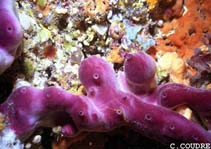
Very variable morphology: crusts massive, reticules, reniform or irregular, thick several cm. Surface more or less smooth, with many oscules, with relatively uniform distribution. Consistency lasts. Coloring varying of the pure white to brown to nuances violets. Interior of sponge also of clear color (Ref. 358).
Habitat: Various rock funds, caves and cracks, generally beyond 5 m and until the great depths. Biology: coloring is related to the presence of symbiotic algae: the non exposed fabrics and the individuals living inside underwater excavations are clear, which is explained by the absence or the scarcity of these chlorophyllian algae. In all the other cases, these spongiae is of darker color. The dory Peltodoris atromaculata almost exclusively nourishes fabrics of this species, whose each colony is frequently the prey of many specimens. As for sponges while not comprising, it is not rare to detect these traces of bites in the form of prints faded in the extreme cases; only one Petrosia sp. can be the prey of 40 mackled dory of all sizes (Ref. 358).
Cycle de vie et comportement reproducteur
Maturité | Reproduction | Frai | Œufs | Fécondité | Larves
Members of the class Demospongiae are hermaphroditic. Life cycle: The zygote develops into parenchymella larva (free-swimming) before settling down on a substrate where it grows into a young sponge.
Göthel, H. 1992 Guide de la faune sous-marine: La Méditerranée. Invertébrés marins et poissons. Eygen Ulmer GmbH & Co. 318 p. (Réf. 358)
Statut dans la liste rouge de l'IUCN
(Réf. 130435: Version 2025-2 (Global))
statut CITES (Réf. 108899)
Not Evaluated
Not Evaluated
Menace pour l'homme
Utilisations par l'homme
FAO - Publication: search | FishSource |
Outils
Plus d'informations
Écologie trophiqueAliments (proies)
Composition du régime alimentaire
Consommation alimentaire
Prédateurs
Dynamique des populationsCroissance
Âges / tailles maximales
Longueur-poids rel.
Rel. longueur-longueur.
Fréquences de longueurs
Conversion de masse
Abondance
Cycle de vieReproductionMaturitéFéconditéFraiŒufsDéveloppement de l'œufLarves PhysiologieConsommation d'oxygène
Liées à l'hommeTimbres, pièces de monnaie, divers
Sources Internet
Estimations basées sur des modèles
Vulnérabilité de la pêche
(Réf. 71543) |
(0 of 100). |
Catégorie de prix
(Réf. 80766): |
Unknown. |