Ascidiacea |
Phlebobranchia |
Ascidiidae
Environnement : milieu / zone climatique / profondeur / gamme de distribution
Écologie
Sessile; saumâtre; profondeur 0 - 70 m (Réf. 116065). Tropical
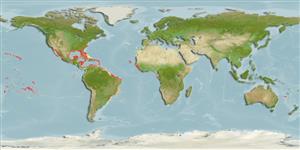
Eastern Central Pacific and Atlantic Ocean.
Longueur à la première maturité / Taille / Poids / Âge
Maturité: Lm ? range ? - ? cm Max length : 10.0 cm TL mâle / non sexé; (Réf. 1757)
May be found in large aggregations. Calm waters (Ref. 415). Solitary: 5 to 10 cm (Ref. 1757). Often attached to bottom rubble or to mangrove roots, but often partly buried in the peat bank (Ref. 1758).
Cycle de vie et comportement reproducteur
Maturité | Reproduction | Frai | Œufs | Fécondité | Larves
Members of the class Ascidiacea are hermaphroditic; both cross- and self-fertilization is typical. Life cycle: Eggs develop into lecithotrophic larva before metamorphosing into benthic adults.
Collin, R., M.C. Díaz, J. Norenburg, R.M. Rocha, J.A. Sánchez, M. Schulze, A. Schwartz and A. Valdés 2005 Photographic identification guide to some common marine invertebrates of Bocas Del Toro, Panama. Caribbean Journal of Science. 41(3):638-707. (Réf. 415)
Statut dans la liste rouge de l'IUCN
(Réf. 130435: Version 2025-2 (Global))
statut CITES (Réf. 108899)
Not Evaluated
Not Evaluated
Menace pour l'homme
Utilisations par l'homme
FAO - Publication: search | FishSource |
Outils
Plus d'informations
Écologie trophiqueAliments (proies)Composition du régime alimentaireConsommation alimentairePrédateurs Dynamique des populationsCroissanceÂges / tailles maximalesLongueur-poids rel.Rel. longueur-longueur.Fréquences de longueursConversion de masseAbondance Cycle de vieReproductionMaturitéFéconditéFraiŒufsDéveloppement de l'œufLarves PhysiologieConsommation d'oxygène
Liées à l'hommeTimbres, pièces de monnaie, divers
Sources Internet
Estimations basées sur des modèles
Vulnérabilité de la pêche
(Réf. 71543) |
Low vulnerability (10 of 100). |
Catégorie de prix
(Réf. 80766): |
Unknown. |