Gastropoda |
Neogastropoda |
Buccinidae
Environnement : milieu / zone climatique / profondeur / gamme de distribution
Écologie
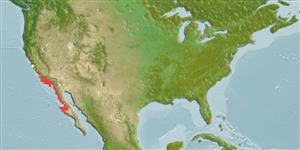
Benthic; profondeur 0 - 69 m (Réf. 865), usually 3 - 40 m (Réf. 106100). Subtropical; 37°N - 27°N, 123°W - 113°W
Eastern Central Pacific: USA to Mexico. From Isla Asuncion, Baja California, Mexico to Monterey, CA, USA.
Longueur à la première maturité / Taille / Poids / Âge
Maturité: Lm ?, range 7 - 9 cm Max length : 17.5 cm SHL mâle / non sexé; (Réf. 865); common length :8.5 cm SHL (female)
It is found in kelp beds on rocky and soft bottoms, from low intertidal to a depth of 69 meters (Ref. 865). Also inhabits sand areas adjacent to more solid substratum. Forms aggregated distribution patterns, most likely as a foraging and/or reproductive strategy. Carnivorous scavenger. Primarily feeds on live sessile polychaetes and solitary tunicates (Ref. 101624).
Cycle de vie et comportement reproducteur
Maturité | Reproduction | Frai | Œufs | Fécondité | Larves
Members of the order Neogastropoda are mostly gonochoric and broadcast spawners (Ref. 833). Life cycle: Eggs capsules (400 to 1200 eggs) are deposited on hard substrate. Embryos develop within the capsule, emerge into the water column as free-swimming veliger larvae and later assumes a benthic life style (Ref. 104623).
Bisby, F.A., M.A. Ruggiero, K.L. Wilson, M. Cachuela-Palacio, S.W. Kimani, Y.R. Roskov, A. Soulier-Perkins and J. van Hertum 2005 Species 2000 & ITIS Catalogue of Life: 2005 Annual Checklist. CD-ROM; Species 2000: Reading, U.K. (Réf. 19)
Statut dans la liste rouge de l'IUCN
(Réf. 130435: Version 2025-2 (Global))
statut CITES (Réf. 108899)
Not Evaluated
Not Evaluated
Menace pour l'homme
Utilisations par l'homme
Pêcheries: commercial
FAO - Publication: search | FishSource |
Outils
Plus d'informations
Dynamique des populationsCroissance
Âges / tailles maximales
Longueur-poids rel.
Rel. longueur-longueur.
Fréquences de longueurs
Conversion de masse
Abondance
PhysiologieConsommation d'oxygène
Liées à l'hommeTimbres, pièces de monnaie, divers
Sources Internet
Estimations basées sur des modèles
Vulnérabilité de la pêche
(Réf. 71543) |
Low vulnerability (10 of 100). |
Catégorie de prix
(Réf. 80766): |
Unknown. |