Ascidiacea |
Stolidobranchia |
Styelidae
Environnement : milieu / zone climatique / profondeur / gamme de distribution
Écologie
Sessile; profondeur 0 - 100 m (Réf. 1603). Temperate; 71°N - 38°S, 180°W - 180°E
Cosmopolitan.
Longueur à la première maturité / Taille / Poids / Âge
Maturité: Lm ? range ? - ? cm Max length : 5.0 cm TL mâle / non sexé; (Réf. 1603)
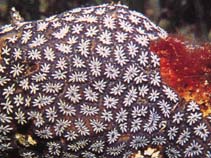
Assumed maximum total length of zooids from Ref. 1603, 2268. Width of encrusting colonies is 10 cm (Ref. 7726). Attached to hard substrata; mainly in shallow water but occasionally to depths of several hundred meters (Ref. 1603). Common encrusting form in shallow subtidal waters on hard surfaces, and covers algae (Ref. 7726). Trophic level: 1.4-1.8; filter-feeder (Ref. 96418).
Cycle de vie et comportement reproducteur
Maturité | Reproduction | Frai | Œufs | Fécondité | Larves
Members of the class Ascidiacea are hermaphroditic; both cross- and self-fertilization is typical. Life cycle: Eggs develop into lecithotrophic larva before metamorphosing into benthic adults.
Jagerskiold, L.A. 1971 A Survey of the Marine Benthoic Macrofauna along the Swedish West Coast 1921-1938. Acta Regiae Societatis Scientiarum et Litterarum Gothoburgensis. Zoologica 6:1-146. (Réf. 1369)
Statut dans la liste rouge de l'IUCN
(Réf. 130435: Version 2025-2 (Global))
statut CITES (Réf. 108899)
Not Evaluated
Not Evaluated
Menace pour l'homme
Utilisations par l'homme
FAO - Publication: search | FishSource |
Outils
Plus d'informations
Écologie trophiqueAliments (proies)
Composition du régime alimentaire
Consommation alimentaire
Prédateurs
Dynamique des populations Cycle de vieReproductionMaturitéFéconditéFraiŒufsDéveloppement de l'œufLarves PhysiologieConsommation d'oxygène
Liées à l'hommeTimbres, pièces de monnaie, divers
Sources Internet
Estimations basées sur des modèles
Vulnérabilité de la pêche
(Réf. 71543) |
Low vulnerability (10 of 100). |
Catégorie de prix
(Réf. 80766): |
Unknown. |