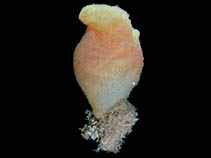
Ascidiacea |
Stolidobranchia |
Styelidae
Milieu: milieu / Klimaatzone / Diepte / verspreidingsgebied
Ecologie
Sessile; diepte 0 - 1549 m (Ref. 3435). Polar
Southwest Atlantic, Southern Pacific and the Antarctic: From Antarctica to sub-Antarctic islands and South America.
Lengte bij maturiteit / Grootte / Gewicht / Leeftijd
Maturiteit: Lm ? range ? - ? cm Max length : 20.0 cm TL mannelijk / geslacht onbekend; (Ref. 2588)
This species is the largest and most abundant Styelidae in the Antarctic Ocean (Ref. 2588). Maximum depth from Ref. 116836. Found on muddy bottoms at depths of 15 to 30 m, on hard bottoms at a depth of 30 m, and on moraine deposits at depths of 25 to 30 m (Ref. 1753), and also from depths of 0 to 200 m (Ref. 3435).
Levenscyclus en paargedrag
Maturiteit | Voortplanting | Paaien | Eieren | Fecunditeit | Larven
Members of the class Ascidiacea are hermaphroditic; both cross- and self-fertilization is typical. Life cycle: Eggs develop into lecithotrophic larva before metamorphosing into benthic adults.
Tatian, M., R.J. Sahade, M.E. Doucet and G.B. Esnal 1998 Ascidians (tunicata, ascidiacea) of Potter cove, South Shetland Islands, Antarctica. Antarc. Sci. 10(2):147-152. (Ref. 1753)
Status op de Rode Lijst van het IUCN
(Ref. 130435: Version 2025-2 (Global))
CITES status (Ref. 108899)
Not Evaluated
Not Evaluated
Gevaar voor de mens
Gebruik door de mens
FAO - Publication: search | FishSource |
Tools
Meer informatie
Trofische ecologieVoedsel (prooien)
Dieetsamenstelling
Voedselconsumptie
Predatoren
LevenscyclusVoortplantingMaturiteitFecunditeitPaaienEierenOntwikkeling van de eierenLarven FysiologieZuurstofverbruik
Menselijk gerelateerdPostzegels, munten, diversen.
Internetbronnen
Schattingen op basis van modellen
Kwetsbaarheid van de visserij
(Ref. 71543) |
Low vulnerability (10 of 100). |
Prijsklasse
(Ref. 80766): |
Unknown. |