Pycnogonida |
Pantopoda |
Nymphonidae
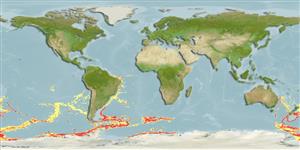
Umwelt: Milieu / Klimazone / Tiefenbereich / Verbreitungsgebiet
Ökologie
Benthic; tiefenbereich 318 - 3000 m (Ref. 2116). Temperate
Southwest Atlantic, South Pacific and the Antarctic.
Länge bei der ersten Reifung / Größe / Gewicht / Alter
Geschlechtsreife: Lm ? range ? - ? cm
Size moderately large, leg span about 82 - 92 mm. Most appendages very long, slender. Trunk and lateral processes well separated, glabrous. Neck of medium length, oviger bases implanted well anterior to first lateral processes, low ocular tubercle placed between oviger bases and first lateral processes. Proboscis rather long, slender, with slight median and distal swelling. Abdomen narrow, short. Xelifore scapes longer than proboscis. Chelae very slender, palms short, fingers very long, overlapping at tips, armed with very many slender sharp teeth. Palps quite slender, third segment about 0.6 length of second, fourth only slightly shorter than fifth (sometimes subequal). Oviger fifth segment longest, slender, distally curved and swollen. Second coxae of legs unusually long, about 4.5 times longer than first coxae. Second tibiae longest segments. Tarsus sometimes shorter, sometimes subequal to propodal length, claw 0.7 length of propodus, sometimes longer, without auxiliaries. Sole of both distal segments with many very short spines (Ref. 9).
Lebenszyklus und Paarungsverhalten
Geschlechtsreife | Fortpflanzung | Ablaichen | Eier | Fruchtbarkeit | Larven
Members of the class Pycnogonida are gonochoric and sexually dimorphic. During copulation, male usually suspends itself beneath the female. Fertilization occurs as the eggs leave the female's ovigers. Males brood the egg masses until they hatch. Life cycle: Eggs hatch into protonymphon larva then to adults.
Child, C.A. 1998 The marine fauna of New Zealand: Pycnogonida (sea spiders). NIWA Biodiversity Memoire 109. National Institute of Water and Atmospheric Research (NIWA). Washington, D.C. 20530, USA. 71 p. + Figure 2A-G, 3A-F, 4, 5. (Ref. 9)
IUCN Rote Liste Status
(Ref. 130435: Version 2025-2 (Global))
CITES Status (Ref. 108899)
Not Evaluated
Not Evaluated
Bedrohung für Menschen
Nutzung durch Menschen
FAO - Publication: search | FishSource |
Tools
Mehr Information
Trophische ÖkologieLebensmittel (Beutetiere)
Nahrungszusammensetzung
Nahrungsaufnahme
Räuber
PopulationsdynamikWachstum
Max. Alter/Größen
Länge-Gewicht-Rel.
Länge-Länge-Verhältnis.
Längenhäufigkeiten
Massenkonvertierung
Dichte
LebenszyklusFortpflanzungGeschlechtsreifeFruchtbarkeitAblaichenEierEientwicklungLarven PhysiologieSauerstoffverbrauch
MenschenbezogenBriefmarken, Münzen, Verschiedenes.
Internet Quellen
Schätzungen auf der Grundlage von Modellen
Anfälligkeit der Fischerei
(Ref. 71543) |
(0 of 100). |
Preiskategorie
(Ref. 80766): |
Unknown. |