Pycnogonida |
Pantopoda |
Nymphonidae
Environnement : milieu / zone climatique / profondeur / gamme de distribution
Écologie
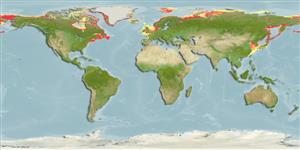
Benthic; profondeur 0 - 100 m (Réf. 256). Boreal
Northwest Pacific, Arctic and Northern Atlantic.
Longueur à la première maturité / Taille / Poids / Âge
Maturité: Lm ? range ? - ? cm
Description synthétique
Morphologie
Trunk glabrous, lateral processes separated by intervals equal to diameters, about 1.5 times longer than diameters. Neck moderately long, ocular tubercle wider than tall, eyes large. Proboscis a cylinder tapering distally. Abdomen short, not as long as fourth lateral processes.
Chelifore scapes as long as proboscis, palm rectangular, with many ventral setae, fingers shorter, slender, carried at acute angle, armed with many tiny teeth. Palp second and third segments subequal, fourth very short, fifth about as long as third, distal 2 segments with many short setae. Oviger terminal claw with many tiny teeth. Legs long, slender, tarsus about 1.5 times longer than slender propodus, both with tiny sole spines. Claw slender, slightly less than half propodus length, auxiliaries less than 0.3 main claw length (Ref. 2153, p. 23).
Shelf (Ref. 19). Sublittoral (Ref. 256).
Cycle de vie et comportement reproducteur
Maturité | Reproduction | Frai | Œufs | Fécondité | Larves
Members of the class Pycnogonida are gonochoric and sexually dimorphic. During copulation, male usually suspends itself beneath the female. Fertilization occurs as the eggs leave the female's ovigers. Males brood the egg masses until they hatch. Life cycle: Eggs hatch into protonymphon larva then to adults.
King, P.E. 1973 Pycnogonids. Hutchinson of London. London, UK. 144 p. (Réf. 12)
Statut dans la liste rouge de l'IUCN
(Réf. 130435: Version 2025-2 (Global))
statut CITES (Réf. 108899)
Not Evaluated
Not Evaluated
Menace pour l'homme
Utilisations par l'homme
FAO - Publication: search | FishSource |
Outils
Plus d'informations
Écologie trophiqueAliments (proies)
Composition du régime alimentaire
Consommation alimentaire
Prédateurs
Dynamique des populationsCroissance
Âges / tailles maximales
Longueur-poids rel.
Rel. longueur-longueur.
Fréquences de longueurs
Conversion de masse
Abondance
Cycle de vieReproductionMaturitéFéconditéFraiŒufsDéveloppement de l'œufLarves PhysiologieConsommation d'oxygène
Liées à l'hommeTimbres, pièces de monnaie, divers
Sources Internet
Estimations basées sur des modèles
Vulnérabilité de la pêche
(Réf. 71543) |
(0 of 100). |
Catégorie de prix
(Réf. 80766): |
Unknown. |