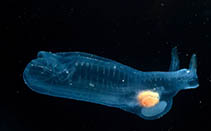
Thaliacea |
Salpida |
Salpidae
Environnement : milieu / zone climatique / profondeur / gamme de distribution
Écologie
Pélagique; profondeur 0 - 150 m (Réf. 2376). Temperate
Indo-Pacific, Atlantic Ocean and the Mediterranean: from New Zealand to Japan, East Pacific Ocean from California to Bering Sea. Tropical to temperate.
Longueur à la première maturité / Taille / Poids / Âge
Maturité: Lm ? range ? - ? cm Max length : 12.0 cm TL mâle / non sexé; (Réf. 1610)
Marine, planktonic; tolerates colder waters than most salps (Refs. 1134, 126266). Associated with an attached phyllosomata of the western rock lobster Panulirus cygnus, which was found to consume its host's tissue, exhibiting opportunistic feeding (Ref. 108806).
Cycle de vie et comportement reproducteur
Maturité | Reproduction | Frai | Œufs | Fécondité | Larves
Members of the order Salpida includes clonal and sexual phases in its life cycle. Life cycle: The oozooid holds in its stolon the buds and blastozooids, each containing an egg. The blastozooid becomes a brood sac for the fertilized egg which later breaks free as a young zooid.
Kott, P. 2005 Catalogue of Tunicata in Australian Waters. Queensland Museum, Brisbane, Australia Department of the Environment and Heritage. (Réf. 1134)
Statut dans la liste rouge de l'IUCN
(Réf. 130435: Version 2025-2 (Global))
statut CITES (Réf. 108899)
Not Evaluated
Not Evaluated
Menace pour l'homme
Utilisations par l'homme
FAO - Publication: search | FishSource |
Outils
Plus d'informations
Écologie trophiqueAliments (proies)Composition du régime alimentaireConsommation alimentairePrédateurs Dynamique des populationsCroissance
Âges / tailles maximales
Longueur-poids rel.
Rel. longueur-longueur.
Fréquences de longueurs
Conversion de masse
Abondance
Cycle de vieReproductionMaturitéFéconditéFraiŒufsDéveloppement de l'œufLarves PhysiologieConsommation d'oxygène
Liées à l'hommeTimbres, pièces de monnaie, divers
Sources Internet
Estimations basées sur des modèles
Vulnérabilité de la pêche
(Réf. 71543) |
Low vulnerability (10 of 100). |
Catégorie de prix
(Réf. 80766): |
Unknown. |