Pycnogonida |
Pantopoda |
Ammotheidae
पर्यावरण: पर्यावरण / जलवायु क्षेत्र / गहराई सीमा / वितरण सीमा
पारिस्थितिकी
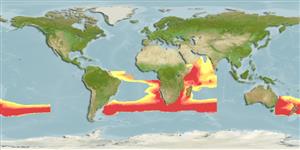
बैथीपिलाजिक; गहराई सीमा 183 - 1789 m (संदर्भ 9). Subtropical
Southeast Atlantic and Indo-West Pacific.
प्रथम परिपक्वता पर लंबाई / आकार / वज़न / आयु
परिपक्व अवधि: Lm ? range ? - ? cm
Trunk: fully segmented with long neck and closely spaced lateral processes. Tall dorsomedian trunk tubercles have 2 to 3 long lateral setae, ocular tubercle at extreme anterior of segment is tall slender cone without eyes, with pair of long setae flanking posterior base. Anterior of cephalic segment flaring, with low tubercles each having short seta which match dorsodistal rims of lateral processes. Some short setae on anterior and posterior of each lateral process. Proboscis: large, ovoid, without constrictions. Abdomen: moderately long, distally swollen, bearing 2 to short dorsal setae. Chelifores: very short, scapes 2 segmented, first segment extremely short, hidden by cephalic segment hood, both armed with several long setae. Chelae: atrophied, tiny slender cones with lateral stub representing movable finger. Palps: typical, 9 segmented. Ovigers: Ammothella-like, with non-functioning strigilis having 2 to 3 slender denticulate spines. Terminal: segment not longer than wide. Legs: long, slender, with many long lateral and dorsal setae. Propodus: slender, well curved, with 3 larger heel spines and many smaller sole spines. Claw: quite long, strongly curved, auxiliaries very short. Male cement gland tube: not within conical tubercle, situated at about 0.6 length of femur dorsum, angled distally (Ref. 9).
Depth based on occurrence record; to be replaced with better reference.
जीवन चक्र और संभोग व्यवहार
परिपक्व अवधि | पुनरुत्पत्ति | मछलीऔ का अंडे देना | अंडे | उपजाऊपन | लार्वा
Members of the class Pycnogonida are gonochoric and sexually dimorphic. During copulation, male usually suspends itself beneath the female. Fertilization occurs as the eggs leave the female's ovigers. Males brood the egg masses until they hatch. Life cycle: Eggs hatch into protonymphon larva then to adults.
Child, C.A. 1998 The marine fauna of New Zealand: Pycnogonida (sea spiders). NIWA Biodiversity Memoire 109. National Institute of Water and Atmospheric Research (NIWA). Washington, D.C. 20530, USA. 71 p. + Figure 2A-G, 3A-F, 4, 5. (संदर्भ 9)
आईयूसीएन रेड लिस्ट स्थिति
(संदर्भ 130435: Version 2025-2 (Global))
CITES स्थिति (संदर्भ 108899)
Not Evaluated
CMS (संदर्भ 116361)
Not Evaluated
मनुष्यों के लिए ख़तरा
मानव उपयोग
FAO - Publication: search | FishSource |
साधन
अधिक जानकारी
ट्रॉफिक पारिस्थितिकीखाद्य पदार्थ (शिकार)
संघटक आहार
आहार खपत
परभक्षी
जनसंख्या गतिशीलताबाढ़
अधिकतम आयु/आकार
लंबाई-वजन संबंध
लंबाई-लंबाई संबंध
लंबाई-आवृत्तियाँ
सामूहिक रूपांतरण
बहुतायत
जीवन चक्रपुनरुत्पत्तिपरिपक्व अवधिउपजाऊपनमछलीऔ का अंडे देनाअंडेअंडे का विकासलार्वा फिजियोलॉजीप्राणवायु की खपत
मानव संबंधीटिकट, सिक्के, विविध.
इंटरनेट स्रोत
मॉडल पर आधारित अनुमान
मछली पकड़ने की भेद्यता
(संदर्भ 71543) |
(0 of 100). |
मूल्य श्रेणी
(संदर्भ 80766): |
Unknown. |