Pycnogonida |
Pantopoda |
Ammotheidae
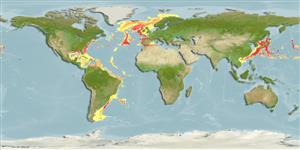
Miljö: miljö / Klimatzon / djupintervall / distributionsområde
Ekologi
Benthic; djupintervall 70 - 2775 m (Ref. 1797). Subtropical
Northern Pacific, Atlantic Ocean and the Mediterranean: Korea and Japan.
Längd vid första mognad / Storlek / Vikt / Ålder
Könsmognad: Lm ? range ? - ? cm
Trunk unsegmented, compact, with tubercles or spines only on lateral processes; lateral processes long, separated by half their diameters proximally, without setae, but with tall dorsodistal tubercles and sometimes with small, lateral spinose tubercles. Ocular tubercles erect, almost as tall as abdomen; eyes lacking. Proboscis very short, subconical. Abdomen very tall, erect. Chelifore scapes I-segmented; chelae fully developed, with functional fingers. Palps usually 6 segmented, short. Ovigers 10 segmented, short, without functional strigilis; terminal segments with simple spines. Legs slender, with rows of short setae; terminal segments cylindrical; tarsus almost as long as propodus, both with row of short sole spines; propodus without heel or heel spines; claw long, without auxiliaries. Tall, conical lateral process tubercles with broad bases, and base of proboscis not bulbous but more conical; tarsus and propodus together subequal to second tibia in length (Ref. 2115, p. 31-32).
Minimum depth from Ref. 116112. Coastal to slope (Ref. 1797 and 19). Deep sea species (Ref. 116112).
Livscykel och parningsbeteende
Könsmognad | Reproduktion | Lek | Ägg | Fekunditet | Larver
Members of the class Pycnogonida are gonochoric and sexually dimorphic. During copulation, male usually suspends itself beneath the female. Fertilization occurs as the eggs leave the female's ovigers. Males brood the egg masses until they hatch. Life cycle: Eggs hatch into protonymphon larva then to adults.
Bamber, R.N. and M.H. Thurston 1995 The deep-water pycnogonids (Arthropoda, Pycnogonida) of the northeastern Atlantic Ocean. Zoological Journal of the Linnean Society. 115:117-162. (Ref. 1797)
Status på IUCN:s rödlista
(Ref. 130435: Version 2025-2 (Global))
CITES-status (Ref. 108899)
Not Evaluated
Not Evaluated
Hot mot människor
Mänskliga användningsområden
FAO - Publication: search | FishSource |
Verktyg
Ytterligare information
Trofisk ekologiLivsmedelsartiklar (preys)
Födosammansättning
Födointag
Predatorer
PopulationsdynamikTillväxt
Max. åldrar / storlekar
Längd-vikt rel.
Längd-längd rel.
Längd-frekvenser
Massakonvertering
Abundans
LivscykelReproduktionKönsmognadFekunditetLekÄggUtveckling av äggLarver MänniskorelateradFrimärken, mynt, diverse.
Internet-källor
Uppskattningar baserade på modeller
Sårbarhet i fisket
(Ref. 71543) |
(0 of 100). |
Priskategori
(Ref. 80766): |
Unknown. |