Pycnogonida |
Pantopoda |
Ammotheidae
Umwelt: Milieu / Klimazone / Tiefenbereich / Verbreitungsgebiet
Ökologie
Benthic; tiefenbereich 5 - 200 m (Ref. 1456). Tropical
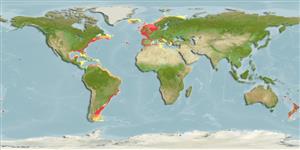
Indo-West Pacific, Southwest Atlantic, North Atlantic, and the Mediterranean: Africa and West Atlantic.
Länge bei der ersten Reifung / Größe / Gewicht / Alter
Geschlechtsreife: Lm ? range ? - ? cm
Ocular tubercle low, with tiny apical cone. Proboscis ovoid, with distal constriction around mouth. Abdomen ovoid, extending almost to distal rim of first coxae of fourth leg pair, with 4 to 6 short distal setae. Chelifores with single short segment, about twice as long as wide, each with 3 distal setae; chelae absent. Palps 5 segmented (sometimes 6), extending slightly beyond proboscis; third segment longest. Ovigers 10-segmented, smaller in female; seventh segment of male without typical apophysis ("elbow") but with 3 or 4 long spines; terminal segment tiny, with 2 long, simple spines. Legs robust, with typical setose dorsal swellings; propodus large, with dorsal and lateral setae, 3 large heel spines, and auxiliary claws more than half length of robust main claw (Ref. 2115, p. 35).
Minimum depth from Ref. 116112. Epibiotic (Ref. 116112). Common inhabitant of Sargassum sp. (Ref. 2115, page 35). Feeds on a demosponge (Ref. 121217).
Lebenszyklus und Paarungsverhalten
Geschlechtsreife | Fortpflanzung | Ablaichen | Eier | Fruchtbarkeit | Larven
Members of the class Pycnogonida are gonochoric and sexually dimorphic. During copulation, male usually suspends itself beneath the female. Fertilization occurs as the eggs leave the female's ovigers. Males brood the egg masses until they hatch. Life cycle: Eggs hatch into protonymphon larva then to adults.
Australian Biological Resources Study 2000 Australian Faunal Directory. World Wide Web electronic publication. http://www.deh.gov.au/biodiversity/abrs/online-resources/fauna/index.html (Ref. 1456)
IUCN Rote Liste Status
(Ref. 130435: Version 2025-2 (Global))
CITES Status (Ref. 108899)
Not Evaluated
Not Evaluated
Bedrohung für Menschen
Nutzung durch Menschen
FAO - Publication: search | FishSource |
Tools
Mehr Information
PopulationsdynamikWachstum
Max. Alter/Größen
Länge-Gewicht-Rel.
Länge-Länge-Verhältnis.
Längenhäufigkeiten
Massenkonvertierung
Dichte
LebenszyklusFortpflanzungGeschlechtsreifeFruchtbarkeitAblaichenEierEientwicklungLarven PhysiologieSauerstoffverbrauch
MenschenbezogenBriefmarken, Münzen, Verschiedenes.
Internet Quellen
Schätzungen auf der Grundlage von Modellen
Anfälligkeit der Fischerei
(Ref. 71543) |
(0 of 100). |
Preiskategorie
(Ref. 80766): |
Unknown. |