Pycnogonida |
Pantopoda |
Callipallenidae
Окружающая среда: среда / климатическая зона / пределы глубины / диапазон распространения
экология
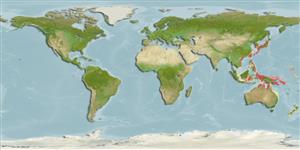
Benthic; пределы глубины 0 - 20 m (ссылка 140). Tropical
Indo-West Pacific.
Длина при первой зрелости / Размер / Вес / Возраст
половая зрелость: Lm ? range ? - ? cm Max length : 0.5 cm LS самец/пол неопределен; (ссылка 6)
Size: Small, leg span about 5.1 mm. Trunk: Fully segmented. Lateral processes: compact, separated by slightly less than their diameters with anterior pairs, more closely crowded, length 1.5 longer than their diameters, armed with laterodistal short setae, single dorsal seta on second and third pairs. Neck: Short, without parallel sides. Ocular tubercle: Low broad swelling with large eyes and prominent sensory papillae. Abdomen: Typical of genus, short, directed horizontally, glabrous. Proboscis: Short, broad, only slightly longer than basal width, egg-shaped distally, lips flat. Chelifore: Scape robust, fairly short, armed with few setae. Palm: Ovoid, armed with several distal setae. Movable finger: Longer than palm, with 6 large teeth decreasing in size distally. Immovable finger: Shorter, with proximal setae and four large teeth. Finger tips overlap when closed. Palps: Very small, less than half length of proboscis, of two segments. First segment broader than long, without setae, second segment slightly over three times longer than its diameter, armed with two distal setae as long as twice segment diameter. Oviger: Segments 3 through 6 with several lateral and ectal recurved setae. Strigilis: Denticulate spines arranged in single row in the formula 9:7:7:8. Spines: Dimorphic with proximal spines symmetrical, distal spines with short distal lobes and long lateral lobes, longer on one side than other. Legs: With few setae, dorsodistal setae of main segments not as long as segment diameters. Femur: The longest segment, tibiae increasingly shorter. Cement gland: Tubes very short, less than three times longer than their diameters, distally constricted, arranged on femur with one tube, first tibia with one tube, and second tibia with two tubes, each segment apparently containing a separate ventral gland. Tarsus: Very short, triangular, armed with ectal and endal setae. Propodus: Robust, tapering distally, with narrow strongly projecting heel armed with two strong spines, the distal one having few crenulations on distal surface. Sole: armed with eight or nine low broad spines and several short lateral setae. Claw: Robust, well curved, slightly over half length of propodus, without auxiliaries. Female: Larger than male in all measurements except oviger. Neck: Longer with parallel sides. Propodal: Heel not projecting but armed with slightly longer spines. Oviger strigilis: Smaller, more denticulate spines in the formula 12: 10:9: 12, spines dimorphic as in male (Ref. 6).
Жизненный цикл и брачное поведение
половая зрелость | размножение | нерест | икра | Плодовитость | личинки
Members of the class Pycnogonida are gonochoric and sexually dimorphic. During copulation, male usually suspends itself beneath the female. Fertilization occurs as the eggs leave the female's ovigers. Males brood the egg masses until they hatch. Life cycle: Eggs hatch into protonymphon larva then to adults.
Основная ссылка
ссылки | координатор | соавторы
Child, C.A. 1988 Pycnogonida of the Western Pacific Islands, III: Recent Smithsonian-Philippine Expeditions. Smithsonian Contribution to Zoology No. 468. Smithsonian Instition Press. Washington, DC. 32 p. + Figure 1 -3. (ссылка 6)
Статус Красного Списка МСОП
(ссылка 130435: Version 2025-2 (Global))
Статус СИТЕС (ссылка 108899)
Not Evaluated
CMS (ссылка 116361)
Not Evaluated
Угроза для людей
Использование человеком
FAO - Publication: search | FishSource |
инструменты
дополнительная информация
Трофическая экологияПищевые предметы (добыча)
состав пищи
потребление пищи
хищники
Динамика численности населениярост
Макс. возраст / размер
Отношение длины к весу.
Отношение длины к длине.
Размерный состав
Преобразование массы
численность
Жизненный циклразмножениеполовая зрелостьПлодовитостьнерестикраРазвитие икрыличинки ФизиологияПотребление кислорода
Связанные с человекомМарки, монеты и прочее.
Информационно-просветительская работа
ресурсы в Интернет
Оценки, основанные на моделях
Уязвимость рыбной ловли
(ссылка 71543) |
Low vulnerability (10 of 100). |
Категория цены
(ссылка 80766): |
Unknown. |