Pycnogonida |
Pantopoda |
Nymphonidae
Entorno: milieu / zona climática / rango de profundidad / gama de distribución
Ecología
Benthic; rango de profundidad 0 - 402 m (Referencia 2090). Tropical
Distribución
Territories | Áreas FAO | Ecosistemas | Ocurrencias, apariciones | Introducciones
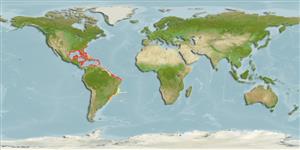
Western Central Atlantic.
Longitud en la primera madurez / Tamaño / Peso / Edad
Madurez: Lm ? range ? - ? cm
Trunk and neck elongate, sides of neck parallel. Ocular tubercle narrow, short; eyes moderately large. Proboscis inflated proximally, rounded distally in lateral view. Chelifore palms very inflated in male; fingers as long as palms, each with 15 to 19 bicuspid teeth. Palp second and third segments subequal. Oviger fourth segment glabrous or with few distal setae. Tarsus short, about 0.4 length of propodus; claw about equal in length to auxiliary claws (Ref. 2115, p. 71).
Found on the bay and nearshore to slope. Epibiotic (Ref. 116112).
Ciclo vital y comportamiento de apareamiento
Madurez | Reproducción | Puesta | Huevos | Fecundidad | Larva
Members of the class Pycnogonida are gonochoric and sexually dimorphic. During copulation, male usually suspends itself beneath the female. Fertilization occurs as the eggs leave the female's ovigers. Males brood the egg masses until they hatch. Life cycle: Eggs hatch into protonymphon larva then to adults.
Child, C.A. 2004 Some Pycnogonida from the Western Caribbean with descriptions of three new species. Bull. Mar. Sci. 74(1):143-161. (Referencia 2090)
Situación en la Lista Roja de la UICN
(Referencia 130435: Version 2025-2 (Global))
Estatus CITES (Referencia 108899)
Not Evaluated
CMS (Referencia 116361)
Not Evaluated
Amenaza para el ser humano
Usos humanos
FAO - Publication: search | FishSource |
Herramientas
Más información
Ecología TróficaAlimentos (presas)
Composición de la dieta
consumo de alimento
Despredadores
Dinámica de la poblaciónCrecimiento
Edades / tallas máximas
Longitud-peso rel.
Longitud-longitud rel.
Longitud-frecuencias
Conversión de masas
Abundancia
Ciclo de vidaReproducciónMadurezFecundidadPuestaHuevosDesarrollo de los huevosLarva FisiologíaConsumo del oxígeno
Relacionados con el ser humanoSellos, monedas, varios
Fuentes de Internet
Estimaciones basadas en modelos
Vulnerabilidad pesquera
(Referencia 71543) |
(0 of 100). |
Categoría de precios
(Referencia 80766): |
Unknown. |