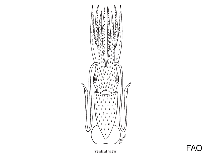
Cephalopoda |
Oegopsida |
Histioteuthidae
Environnement : milieu / zone climatique / profondeur / gamme de distribution
Écologie
Pélagique; profondeur 100 - 850 m (Réf. 97142). Temperate; 52°N - 43°S, 34°E - 7°W (Réf. 275)
Circumglobal in northern and southern warm temperate waters.
Longueur à la première maturité / Taille / Poids / Âge
Maturité: Lm ? range ? - ? cm Max length : 21.0 cm ML mâle / non sexé; (Réf. 97142); 24 cm ML (female)
This species is an important prey for commercial species of fishes (Ref. 97142). Off Hawaii, occurs between depths of 100 and 850 m; in daytime it concentrates at 500 to 700 m (range 355 to 850 m) and vertically migrates at night to depths of 100 to 500 m with 85% concentrated at 150 to 300 m. In the northwestern Pacific transitional warm core rings and cold water, this species is a non-migrant, remaining below 400 m. Analysis of stomach contents from sperm whales off Japan suggests that mature females occur in a dense aggregation adjacent to an isolated oceanic rise. This species is extremely important prey for sperm whales and other odontocete whales, including short-finned pilot whales and Hubb’s beaked whale. Other predators include blue sharks in the northwestern Pacific. It is reported from the stomachs of swordfish off the west coast of Baja California, Mexico. Analysis of the dimorphic eyes suggests that the large left eye points upward and the small right eye points ventrolaterally when the animal is in its normal oblique, arms downward, position. This enables the squid in its daytime depth of 500 to 700 m, to use its large eye to utilize the dim daylight from above, while the small right eye perceives bioluminescent light from the side and below (Ref. 97142).
Cycle de vie et comportement reproducteur
Maturité | Reproduction | Frai | Œufs | Fécondité | Larves
Members of the class Cephalopoda are gonochoric. Male and female adults usually die shortly after spawning and brooding, respectively. Mating behavior: Males perform various displays to attract potential females for copulation. During copulation, male grasp the female and inserts the hectocotylus into the female's mantle cavity where fertilization usually occurs. Life cycle: Embryos hatch into planktonic stage and live for some time before they grow larger and take up a benthic existence as adults.
Roper, C.F.E., M.J. Sweeney and C.E. Nauen 1984 FAO Species Catalogue. Vol. 3. Cephalopods of the world. An annotated and illustrated catalogue of species of interest to fisheries. FAO Fish. Synop. 125(3):277p. Rome: FAO. (Réf. 275)
Statut dans la liste rouge de l'IUCN
(Réf. 130435: Version 2025-2 (Global))
statut CITES (Réf. 108899)
Not Evaluated
Not Evaluated
Menace pour l'homme
Utilisations par l'homme
FAO - Publication: search | FishSource |
Outils
Plus d'informations
Dynamique des populationsCroissance
Âges / tailles maximales
Longueur-poids rel.
Rel. longueur-longueur.
Fréquences de longueurs
Conversion de masse
Abondance
Cycle de vieReproductionMaturitéFéconditéFraiŒufsDéveloppement de l'œufLarves PhysiologieConsommation d'oxygène
Liées à l'hommeTimbres, pièces de monnaie, divers
Sources Internet
Estimations basées sur des modèles
Vulnérabilité de la pêche
(Réf. 71543) |
Low vulnerability (14 of 100). |
Catégorie de prix
(Réf. 80766): |
Medium. |