Palaeonemertea |
Tubulaniformes |
Tubulanidae
Environnement : milieu / zone climatique / profondeur / gamme de distribution
Écologie
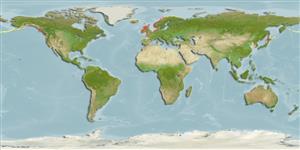
Benthic; saumâtre; profondeur 0 - 45 m (Réf. 124752). Temperate; 63°N - 30°N, 180°W - 37°E
Northeast Atlantic, Arctic Sea, the Mediterranean and Northern Pacific.
Longueur à la première maturité / Taille / Poids / Âge
Maturité: Lm ? range ? - ? cm Max length : 300 cm TL mâle / non sexé; (Réf. 930)
Inhabits estuarine and inshore areas, in mud, silt, and fine sand substrates (Ref. 96352). Found under rocks and among mussels and other attached organisms in intertidal to shallow subtidal zones. Occurs at the low tide mark (Ref. 966). A carnivore-scavenger (Ref. 96352).
Cycle de vie et comportement reproducteur
Maturité | Reproduction | Frai | Œufs | Fécondité | Larves
Members of the phylum Nemertea are mostly gonochoric. Life cycle: Eggs hatch and develop into short-lived lecitotrophic larvae before metamorphosing into juveniles and further into adults.
Blake, J.A. 1993 6. Phylum Nemertea. p. 95-132. In Blake, J.A. and A. Lissner (eds.) Taxonomic Atlas of the Benthic Fauna of the Santa Maria Basin and Western Santa Barbara Channel. Vol. 1. Introduction, benthic ecology, oceanography, Platyhelminthes, and Nemertea. (Réf. 966)
Statut dans la liste rouge de l'IUCN
(Réf. 130435: Version 2025-2 (Global))
statut CITES (Réf. 108899)
Not Evaluated
Not Evaluated
Menace pour l'homme
Utilisations par l'homme
FAO - Publication: search | FishSource |
Outils
Plus d'informations
Écologie trophiqueAliments (proies)
Composition du régime alimentaire
Consommation alimentaire
Prédateurs
Dynamique des populationsCroissance
Âges / tailles maximales
Longueur-poids rel.
Rel. longueur-longueur.
Fréquences de longueurs
Conversion de masse
Abondance
Cycle de vieReproductionMaturitéFéconditéFraiŒufsDéveloppement de l'œufLarves PhysiologieConsommation d'oxygène
Liées à l'hommeTimbres, pièces de monnaie, divers
Sources Internet
Estimations basées sur des modèles
Vulnérabilité de la pêche
(Réf. 71543) |
Very high vulnerability (90 of 100). |
Catégorie de prix
(Réf. 80766): |
Unknown. |