Cephalopoda |
Octopoda |
Eledonidae | Eledoninae
Environnement : milieu / zone climatique / profondeur / gamme de distribution
Écologie
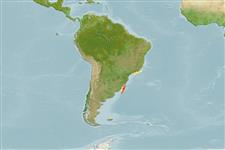
Benthic; profondeur 52 - 140 m (Réf. 96968). Subtropical; 22°S - 36°S, 54°W - 40°W
Southwest Atlantic: Brazil.
Longueur à la première maturité / Taille / Poids / Âge
Maturité: Lm 1.7 range ? - ? cm Max length : 6.5 cm ML mâle / non sexé; (Réf. 96968)
Frequently caught in bottom trawls together with Eledone massyae Voss, 1964 (Ref. 104514). Benthic (Ref. 104514). Coexists with Eledone massyae along continental shelf and slope. Inhabits soft bottoms, on both sandy and muddy bottoms (Ref. 104173). Likely to move to rocky bottoms of the upper slope to spawn and breed (Ref. 106242). Feeds mainly on crustaceans such as benthic amphipods and isopods (Ref. 104173).
Cycle de vie et comportement reproducteur
Maturité | Reproduction | Frai | Œufs | Fécondité | Larves
Members of the class Cephalopoda are gonochoric. Male and female adults usually die shortly after spawning and brooding, respectively. Mating behavior: Males perform various displays to attract potential females for copulation. During copulation, male grasp the female and inserts the hectocotylus into the female's mantle cavity where fertilization usually occurs. Life cycle: Embryos hatch into planktonic stage and live for some time before they grow larger and take up a benthic existence as adults (Ref. 833).
Wood, J.B. and C.L. Day 1998 CephBase. http://www.cephbase.utmb.edu/. [Accessed 26/01/06]. (Réf. 3722)
Statut dans la liste rouge de l'IUCN
(Réf. 130435: Version 2025-2 (Global))
statut CITES (Réf. 108899)
Not Evaluated
Not Evaluated
Menace pour l'homme
Utilisations par l'homme
Pêcheries: commercial
FAO - Publication: search | FishSource |
Outils
Plus d'informations
Dynamique des populationsCroissance
Âges / tailles maximales
Longueur-poids rel.
Rel. longueur-longueur.
Fréquences de longueurs
Conversion de masse
Abondance
PhysiologieConsommation d'oxygène
Liées à l'hommeTimbres, pièces de monnaie, divers
Sources Internet
Estimations basées sur des modèles
Vulnérabilité de la pêche
(Réf. 71543) |
Low vulnerability (10 of 100). |
Catégorie de prix
(Réf. 80766): |
Medium. |