Cephalopoda |
Sepiida |
Sepiolidae | Rossiinae
Environnement : milieu / zone climatique / profondeur / gamme de distribution
Écologie
Bathydémersal; profondeur 40 - 1535 m (Réf. 1695). Tropical; 66°N - 55°S, 60°W - 36°E (Réf. 107071)
Atlantic Ocean and the Mediterranean: from southwest Iceland to Southern Africa and Falkland Islands.
Longueur à la première maturité / Taille / Poids / Âge
Maturité: Lm ? range ? - ? cm Max length : 5.1 cm ML mâle / non sexé; (Réf. 1695); 8.3 cm ML (female)
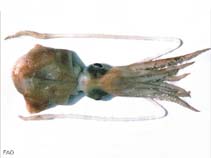
Most bathyal among the members of the family. Demersal. Prefers deep muddy bottoms characterized by Isidella elongata populations, often overlapping with Rossia macrosoma in the upper level of its distributional range and frequently associated with Sepietta oweniana and Rondeletiola minor. In the western Mediterranean, it is the most common cephalopod captured between 1000 and 2000 m, along with Bathypolypus sponsalis but is most abundant between 400 and 600 to 700 m in both eastern and western parts of this sea. Mature individuals found throughout the year suggest an extended spawning season. Its large eggs (8-10 mm diameter and covered by a hard violet-coloured coating), are attached to hard substrates at various depths. Lifespan approximated between 12 and 24 months. Usually taken as trawl fishery bycatch; of minor commercial importance. Sold fresh and frozen in fish markets with other bobtail squids (Ref. 1695).
Cycle de vie et comportement reproducteur
Maturité | Reproduction | Frai | Œufs | Fécondité | Larves
Members of the class Cephalopoda are gonochoric. Male and female adults usually die shortly after spawning and brooding, respectively. Mating behavior: Males perform various displays to attract potential females for copulation. During copulation, male grasp the female and inserts the hectocotylus into the female's mantle cavity where fertilization usually occurs. Life cycle: Embryos hatch into planktonic stage and live for some time before they grow larger and take up a benthic existence as adults.
Jereb, P. and C.F.E. Roper (eds.) 2005 Cephalopods of the world. An Annotated and Illustrated catalogue of Cephalopod species known to date. Vol. 1. Chambered nautiluses and sepioids (Nautilidae, Sepiidae, Sepiolidae, Sepiadariidae, Idiosepiidae and Spirulidae). FAO Spec. Cat. Fish. Purp. 4(1):262p. Rome: FAO. (Réf. 1695)
Statut dans la liste rouge de l'IUCN
(Réf. 130435: Version 2025-2 (Global))
statut CITES (Réf. 108899)
Not Evaluated
Not Evaluated
Menace pour l'homme
Utilisations par l'homme
Pêcheries: intérêt commercial mineur
FAO - Publication: search | FishSource |
Outils
Plus d'informations
Écologie trophiqueAliments (proies)
Composition du régime alimentaire
Consommation alimentaire
Prédateurs
Dynamique des populations Cycle de vieReproductionMaturitéFéconditéFraiŒufsDéveloppement de l'œufLarves PhysiologieConsommation d'oxygène
Liées à l'hommeTimbres, pièces de monnaie, divers
Sources Internet
Estimations basées sur des modèles
Vulnérabilité de la pêche
(Réf. 71543) |
Low vulnerability (10 of 100). |
Catégorie de prix
(Réf. 80766): |
Unknown. |