Cephalopoda |
Oegopsida |
Cranchiidae | Taoniinae
Environnement : milieu / zone climatique / profondeur / gamme de distribution
Écologie
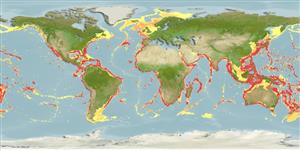
Pélagique; profondeur 0 - 2000 m (Réf. 97142). Tropical
Circumglobal. Tropical to temperate climates.
Longueur à la première maturité / Taille / Poids / Âge
Maturité: Lm ? range ? - ? cm Max length : 42.0 cm ML mâle / non sexé; (Réf. 97142)
The vertical distribution of paralarvae to approximately 35 mm mantle length is epipelagic, concentrated in subsurface water to 200 m both day and night. With growth and metamorphosis (around 35 to 40 mm mantle length) juveniles broaden their range in the mesopelagic zone to 800 m or more. One subadult female was captured in a closing net at night at 800 to 600 m in the western North Atlantic. Subadults and adults descend into the bathypelagic zone where maturation occurs in the 2,000 m zone. Captures of juveniles and large subadults at night in subsurface waters to about 300 m suggests that a portion of the population undergoes a diel vertical migration (Ref. 97142).
Cycle de vie et comportement reproducteur
Maturité | Reproduction | Frai | Œufs | Fécondité | Larves
Members of the class Cephalopoda are gonochoric. Male and female adults usually die shortly after spawning and brooding, respectively. Mating behavior: Males perform various displays to attract potential females for copulation. During copulation, male grasp the female and inserts the hectocotylus into the female's mantle cavity where fertilization usually occurs. Life cycle: Embryos hatch into planktonic stage and live for some time before they grow larger and take up a benthic existence as adults.
Turgeon, D.D., J.F. Quinn Jr., A.E. Bogan, E.V. Coan, F.G. Hochberg, W.G. Lyons, P.M. Mikkelsen, R.J. Neves, C.F.E. Roper, G. Rosenberg, B. Roth, A. Scheltema, F.G. Thompson, M. Vecchione and J.D. Willams 1998 Common and scientific names of aquatic invertebrates from the United States and Canada: Mollusks, 2nd ed. American Fisheries Society (Special publication 26), Bethesda, Maryland. 526 p. (Réf. 1667)
Statut dans la liste rouge de l'IUCN
(Réf. 130435: Version 2025-2 (Global))
statut CITES (Réf. 108899)
Not Evaluated
Not Evaluated
Menace pour l'homme
Utilisations par l'homme
FAO - Publication: search | FishSource |
Outils
Plus d'informations
Dynamique des populationsCroissanceÂges / tailles maximalesLongueur-poids rel.Rel. longueur-longueur.Fréquences de longueursConversion de masseAbondance Cycle de vieReproductionMaturitéFéconditéFraiŒufsDéveloppement de l'œufLarves PhysiologieConsommation d'oxygène
Liées à l'hommeTimbres, pièces de monnaie, divers
Sources Internet
Estimations basées sur des modèles
Vulnérabilité de la pêche
(Réf. 71543) |
Low to moderate vulnerability (32 of 100). |
Catégorie de prix
(Réf. 80766): |
Medium. |