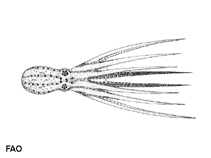
Cephalopoda |
Octopoda |
Octopodidae | Octopodinae
Môi trường: môi trường / vùng khí hậu / Mức độ sâu / phạm vi phân phối
Sinh thái học
Benthic; mức độ sâu 1 - 54 m (Tài liệu tham khảo 96968). Tropical
Pacific Ocean.
Chiều dài lúc trưởng thành đầu tiên / Bộ gần gũi / Khối lượng (Trọng lượng) / Tuổi
Chín muồi sinh dục: Lm ? range ? - ? cm Max length : 32.0 cm TL con đực/không giới tính; (Tài liệu tham khảo 96968); Khối lượng cực đại được công bố: 300.00 g (Tài liệu tham khảo 96968)
Its mantle length is 10 cm (Ref. 96968). Depths range from 1 to 54 m. Occurs on sandy substrates, often associated with coral heads or rubble. Deep lairs are excavated under coral heads or coral rubble on sand substrate. Appears to have crepuscular activity patterns. Lairs are surrounded by cast off gastropod shells which may have been collected for their secondary occupants, hermit crabs. Stomach contents have a high proportion of crustacean exoskeletal fragments. Eggs are laid in large numbers in festoons. The small egg size indicates hatchlings are planktonic. Possibly venomous based on the prominent warning coloration and being locally known as the "poison octopus". Live animals observed to bite objects willingly, uncommon amongst octopuses (Ref. 96968).
Vòng đời và hành vi giao phối
Chín muồi sinh dục | Sự tái sinh sản | Đẻ trứng | Các trứng | Sự sinh sản | Ấu trùng
Members of the class Cephalopoda are gonochoric. Male and female adults usually die shortly after spawning and brooding, respectively. Mating behavior: Males perform various displays to attract potential females for copulation. During copulation, male grasp the female and inserts the hectocotylus into the female's mantle cavity where fertilization usually occurs. Life cycle: Embryos hatch into planktonic stage and live for some time before they grow larger and take up a benthic existence as adults.
Norman, M.D. and C.C. Lu 2000 Preliminary checklist of the cephalopods of the South China Sea. The Raffles Bulletin of Zoology 8:539-567. (Tài liệu tham khảo 81752)
Tình trạng Sách đỏ IUCN
(Tài liệu tham khảo 130435: Version 2025-2 (Global))
tình trạng CITES (Tài liệu tham khảo 108899)
Not Evaluated
CMS (Tài liệu tham khảo 116361)
Not Evaluated
Mối đe dọa đối với con người
Sử dụng của con người
FAO - Publication: search | FishSource |
Các công cụ
Thêm thông tin
Biến động dân sốSự sinh trưởng
Độ tuổi / kích thước tối đa
Chiều dài-trọng lượng tương đối
Chiều dài-chiều dài tương đối.
Chiều dài-tần số
Chuyển đổi khối lượng
Sự phong phú
Vòng đờiSự tái sinh sảnChín muồi sinh dụcSự sinh sảnĐẻ trứngCác trứngSự phát triển của trứngẤu trùng Sinh lý họcThành phần ô-xy
Liên quan đến con ngườiTem, tiền xu, v.v.
Các nguồn internet
Ước tính dựa trên mô hình
Sự dễ bị tổn thương của nghề đánh cá
(Tài liệu tham khảo 71543) |
Low vulnerability (22 of 100). |
Loại giá
(Tài liệu tham khảo 80766): |
Low. |