Cephalopoda |
Oegopsida |
Ommastrephidae | Ommastrephinae
Environnement : milieu / zone climatique / profondeur / gamme de distribution
Écologie
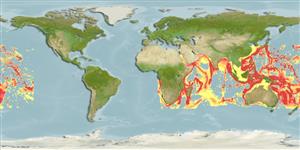
Pélagique. Subtropical; 36°N - 40°S, 9°E - 140°W (Réf. 97142)
Indo-West Pacific: in warm temperate waters.
Longueur à la première maturité / Taille / Poids / Âge
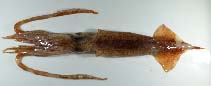
Maturité: Lm ? range ? - ? cm Max length : 31.0 cm ML mâle / non sexé; (Réf. 97142); 25 cm ML (female)
Widely distributed in the tropical-subtropical Indo-Pacific Ocean. Occupies tropical slope and oceanic waters from the surface (adults at night) to moderate depths, at the bottom in the bathyal zone and in midwater above the slope (lower epipelagic, mesopelagic). Paralarvae and juveniles also occur in the equatorial zone in midwater above great oceanic depths, as well as above the tops and slopes of seamounts and mid-ocean ridges. Reproductive strategy adheres to the Sthenoteuthis-type for r-strategists. Females have an asynchronous type of oocyte stock (fecundity) formation by which oogenesis occurs by continuous asynchrony. Spawning is intermittent (batch, pulse) with several egg masses produced over a more or less extended period of time. Intensity of spawning and average egg numbers in these sequential egg masses is approximately constant during the spawning period. Off southeastern Australia, occurs in the deeper shelf and upper continental slope waters that comprise the warm East Australian Current of tropical origin. Size distribution analysis of paralarvae and adults suggests that spawning in this region occurs year-round. In the northern South China Sea, the spawning season is from June to October. In the western North Pacific Ocean, spawning is in the summer and paralarvae are distributed in the Kuroshio Current off Japan. Spawning occurs near the bottom around seamounts and ridges, some after long migrations to these localities. Specimens of 180 to 200 mm mantle length have been captured in trawls fished at 500 to 770 m in the South China Sea; abundance (density index) on the continental slope highest at 400 to 600 m; and most abundant in May and June and during the day than at night. Commonly captured in trawl catches in Australian slope waters. Several specimens have been inadvertently captured when they broke the sea surface and "flew" aboard vessels. Possibly undergoes diel vertical migrations. An actively browsing predator; prey consists of many different food component species of relatively small individual size and weight. Predators include yellowfin tunas (Thunnus albacares), longnose lancetfishes (Alepisaurus ferox), dolphinfishes (Coryphaena hyppurus), swordfish (Xiphias gladius) and numerous other species of pelagic fishes throughout the tropical Indo-Pacific and eastern Pacific Oceans; also, sperm whales prey extensively on this species, as do the South African fur seals (Arctocephalus pusillus pusillus) and several shark species, such as the tiger shark (Galeocerdo cuvier), the scalloped hammerhead shark (Sphyrna lewini) and the smooth hammerhead shark (Sphyrna zygaena). Host to diagenetic trematode parasites (Ref. 97142).
Cycle de vie et comportement reproducteur
Maturité | Reproduction | Frai | Œufs | Fécondité | Larves
Members of the class Cephalopoda are gonochoric. Male and female adults usually die shortly after spawning and brooding, respectively. Mating behavior: Males perform various displays to attract potential females for copulation. During copulation, male grasp the female and inserts the hectocotylus into the female's mantle cavity where fertilization usually occurs. Life cycle: Embryos hatch into planktonic stage and live for some time before they grow larger and take up a benthic existence as adults.
Roper, C.F.E., M.J. Sweeney and C.E. Nauen 1984 FAO Species Catalogue. Vol. 3. Cephalopods of the world. An annotated and illustrated catalogue of species of interest to fisheries. FAO Fish. Synop. 125(3):277p. Rome: FAO. (Réf. 275)
Statut dans la liste rouge de l'IUCN
(Réf. 130435: Version 2025-2 (Global))
statut CITES (Réf. 108899)
Not Evaluated
Not Evaluated
Menace pour l'homme
Utilisations par l'homme
Pêcheries: d'intérêt potentiel
FAO - Publication: search | FishSource |
Outils
Plus d'informations
Dynamique des populationsCroissance
Âges / tailles maximales
Longueur-poids rel.
Rel. longueur-longueur.
Fréquences de longueurs
Conversion de masse
Abondance
Cycle de vieReproductionMaturitéFéconditéFraiŒufsDéveloppement de l'œufLarves PhysiologieConsommation d'oxygène
Liées à l'hommeTimbres, pièces de monnaie, divers
Sources Internet
Estimations basées sur des modèles
Vulnérabilité de la pêche
(Réf. 71543) |
Low vulnerability (21 of 100). |
Catégorie de prix
(Réf. 80766): |
Medium. |