Cephalopoda |
Sepiida |
Sepiolidae | Sepiolinae
Entorno: milieu / zona climática / rango de profundidad / gama de distribución
Ecología
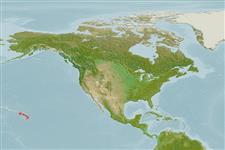
Benthic; rango de profundidad 0 - 1 m (Referencia 118073). Tropical; 25°N - 18°N, 170°W - 154°W
Distribución
Territories | Áreas FAO | Ecosistemas | Ocurrencias, apariciones | Introducciones
Eastern Central Pacific: Hawaiian Islands.
Longitud en la primera madurez / Tamaño / Peso / Edad
Madurez: Lm ? range ? - ? cm Max length : 3.0 cm ML macho / no sexado; (Referencia 1695)
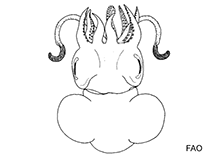
Adults have average mantle length of 2.5 cm. A model organism exhibiting short lifespan, rapid growth, and year-round availability (Ref. 118073). Small, benthic squid (Ref. 118073) found in shallow coastal waters (Refs. 843, 1695), living in muddy and sandy areas near seagrass meadows (Ref. 118075). Hosts a symbiotic luminescent bacteria Vibrio fischeri, the sole bacterium found to naturally thrive in E. scolopes light organ. This symbiont colony reaches as much as 10^9 cells, and remains remarkably monospecific (Ref. 118072). The microbial colony serves as an antipredation measure for the squid, while the microbe gets shelter and nutrition from the squid. When E. scolopes forages at night, the bacterial colony emit light which matches the intensity of the moonlight above it, thus reducing the host's silhouette, preventing it from being eaten by predators in the ocean floor below (Ref. 118071). It also uses another form of camouflage by sticking sand grains to its body (Ref. 118075). A nocturnal predator, the squid finds shelter in the sand during the day and hunts at night over shallow-water sand flats (Ref. 118073). Mainly feeds on the shrimp Palaemon debilis but also consumes small worms (Ref. 122680).
Ciclo vital y comportamiento de apareamiento
Madurez | Reproducción | Puesta | Huevos | Fecundidad | Larva
Members of the class Cephalopoda are gonochoric. Male and female adults usually die shortly after spawning and brooding, respectively. Mating behavior: Males perform various displays to attract potential females for copulation. During copulation, male grasp the female and inserts the hectocotylus into the female's mantle cavity where fertilization usually occurs. Life cycle: Embryos hatch into planktonic stage and live for some time before they grow larger and take up a benthic existence as adults.
Jereb, P. and C.F.E. Roper (eds.) 2005 Cephalopods of the world. An Annotated and Illustrated catalogue of Cephalopod species known to date. Vol. 1. Chambered nautiluses and sepioids (Nautilidae, Sepiidae, Sepiolidae, Sepiadariidae, Idiosepiidae and Spirulidae). FAO Spec. Cat. Fish. Purp. 4(1):262p. Rome: FAO. (Referencia 1695)
Situación en la Lista Roja de la UICN
(Referencia 130435: Version 2025-2 (Global))
Estatus CITES (Referencia 108899)
Not Evaluated
CMS (Referencia 116361)
Not Evaluated
Amenaza para el ser humano
Usos humanos
Pesquerías: sin interés
FAO - Publication: search | FishSource |
Herramientas
Más información
Dinámica de la poblaciónCrecimiento
Edades / tallas máximas
Longitud-peso rel.
Longitud-longitud rel.
Longitud-frecuencias
Conversión de masas
Abundancia
Ciclo de vidaReproducciónMadurezFecundidadPuestaHuevosDesarrollo de los huevosLarva FisiologíaConsumo del oxígeno
Relacionados con el ser humanoSellos, monedas, varios
Fuentes de Internet
Estimaciones basadas en modelos
Vulnerabilidad pesquera
(Referencia 71543) |
Low vulnerability (10 of 100). |
Categoría de precios
(Referencia 80766): |
Unknown. |