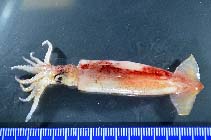
Cephalopoda |
Oegopsida |
Ommastrephidae | Ommastrephinae
Environnement : milieu / zone climatique / profondeur / gamme de distribution
Écologie
Pélagique; profondeur 0 - 1700 m (Réf. 97142). Tropical
Indo-Pacific and Atlantic Ocean.
Longueur à la première maturité / Taille / Poids / Âge
Maturité: Lm ? range ? - ? cm Max length : 8.1 cm ML mâle / non sexé; (Réf. 97142); 10.5 cm ML (female)
Maximum depth from Ref. 110525. Distributed mainly in zones of trade-wind currents and adjoining parts of the central waters of the cyclonic circulations; absent from zones of equatorial divergence. Epipelagic to mesopelagic and upper bathypelagic; inhabits open waters over
great depths of more than 400 m; not related in any biological or oceanographic way to bottom and slope waters. Paralarvae and juveniles inhabit the upper 50 m at night and from 100 to 200 m during the day. Subadult and adult squids inhabit subsurface layers from 15 or 20 m to 150 m at night. Have been occasionally observed at night at the surface. Inhabit depths from 200 to 800 m during the day. Local population numbers are low to moderate. Males reach maturity at 5.0 to 6.5 cm mantle length (age 80 to 100 days), and females mature at 5.0 to 9.0 cm (age 80 to 135 days). No pronounced geographical variability exists for size at maturity or size morphology. Life span is half a year. Spawning occurs throughout the year with some seasonal variability in activity. An intermittent, multibatch spawner. Feeds mainly on juvenile teleosts and squid,
hyperiid amphipods, crab larvae, chaetognaths and to a lesser degree on copepods, shrimps, euphausiids and teleost larvae. Predators include several oceanic species of ommastrephid squids, dolphinfish (Coryphaena sp.), lancet fish (Alepisarus sp.), bonito (Sarda sp.), different species of tunas and sea birds. Off eastern Australia, it is preyed upon by yellow fin tuna (Thunnus albacares). In the tropical Atlantic Ocean, it is an important prey of several fishes such as albacore (T. alalunga), yellowfin tuna, bigeye tuna (T. obesus), sailfish (Istiophorus albicans), blue marlin (Makira nigricans), white marlin (Tetrapturus albidus) and longbill spearfish (T. pfluegeri). Most subadult and adult squids are infested by helminth parasites, principally metacercariae of trematodes of the family Didymozoidae, that are localized in cysts on the inner wall of the stomach (Ref. 97142).
Cycle de vie et comportement reproducteur
Maturité | Reproduction | Frai | Œufs | Fécondité | Larves
Members of the class Cephalopoda are gonochoric. Male and female adults usually die shortly after spawning and brooding, respectively. Mating behavior: Males perform various displays to attract potential females for copulation. During copulation, male grasp the female and inserts the hectocotylus into the female's mantle cavity where fertilization usually occurs. Life cycle: Embryos hatch into planktonic stage and live for some time before they grow larger and take up a benthic existence as adults.
Roper, C.F.E., M.J. Sweeney and C.E. Nauen 1984 FAO Species Catalogue. Vol. 3. Cephalopods of the world. An annotated and illustrated catalogue of species of interest to fisheries. FAO Fish. Synop. 125(3):277p. Rome: FAO. (Réf. 275)
Statut dans la liste rouge de l'IUCN
(Réf. 130435: Version 2025-2 (Global))
statut CITES (Réf. 108899)
Not Evaluated
Not Evaluated
Menace pour l'homme
Utilisations par l'homme
FAO - Publication: search | FishSource |
Outils
Plus d'informations
Dynamique des populationsCroissanceÂges / tailles maximalesLongueur-poids rel.Rel. longueur-longueur.Fréquences de longueursConversion de masseAbondance Cycle de vieReproductionMaturitéFéconditéFraiŒufsDéveloppement de l'œufLarves PhysiologieConsommation d'oxygène
Liées à l'hommeTimbres, pièces de monnaie, divers
Sources Internet
Estimations basées sur des modèles
Vulnérabilité de la pêche
(Réf. 71543) |
Low vulnerability (10 of 100). |
Catégorie de prix
(Réf. 80766): |
Medium. |