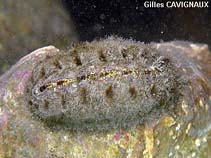
Polyplacophora |
Chitonida |
Acanthochitonidae
Environnement : milieu / zone climatique / profondeur / gamme de distribution
Écologie
Benthic; profondeur 0 - 50 m (Réf. 1878). Temperate
Mediterranean and Atlantic Ocean.
Longueur à la première maturité / Taille / Poids / Âge
Maturité: Lm ? range ? - ? cm Max length : 2.6 cm DL mâle / non sexé; (Réf. 1724)
Substrate consist of red alga Lithophyllum incrustans (Ref. 615, page 105).
Cycle de vie et comportement reproducteur
Maturité | Reproduction | Frai | Œufs | Fécondité | Larves
Members of the class Polyplacophora are mostly gonochoric. Life cycle: Eggs hatch into lecitotrophic planktonic trocophore larvae (no veliger stage) which later metamorphose and settle on the bottom as young adults.
Avila, S.P. and A. Albergaria 2002 The shallow-water Polyplacophora of the Azores and some comments on the biogeographical relationships of the Azorean malacofauna. Bollettino Malacologico, 38(1-4):41-44. (Réf. 1724)
Statut dans la liste rouge de l'IUCN
(Réf. 130435: Version 2025-2 (Global))
statut CITES (Réf. 108899)
Not Evaluated
Not Evaluated
Menace pour l'homme
Utilisations par l'homme
FAO - Publication: search | FishSource |
Outils
Plus d'informations
Écologie trophiqueAliments (proies)
Composition du régime alimentaire
Consommation alimentaire
Prédateurs
Dynamique des populationsCroissance
Âges / tailles maximales
Longueur-poids rel.
Rel. longueur-longueur.
Fréquences de longueurs
Conversion de masse
Abondance
Cycle de vieReproductionMaturitéFéconditéFraiŒufsDéveloppement de l'œufLarves PhysiologieConsommation d'oxygène
Liées à l'hommeTimbres, pièces de monnaie, divers
Sources Internet
Estimations basées sur des modèles
Vulnérabilité de la pêche
(Réf. 71543) |
Low vulnerability (10 of 100). |
Catégorie de prix
(Réf. 80766): |
Unknown. |