Not assigned |
Sipuncula |
Phascolosomatidae
Environnement : milieu / zone climatique / profondeur / gamme de distribution
Écologie
Benthic; profondeur 1 - 110 m (Réf. 116123). Tropical
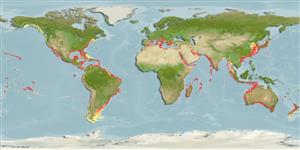
Indo-Pacific, Western Atlantic, East Africa and the Mediterranean Sea. Tropical and subtropical waters.
Longueur à la première maturité / Taille / Poids / Âge
Maturité: Lm ? range ? - ? cm Max length : 4.9 cm TRKL mâle / non sexé; (Réf. 1840)
Common in intertidal coral sands, coralline algae, crevices, under algal mats in tidal pools and at shelf depths (Ref. 1840). Known as a benthic species (Ref. 85346). Common in intertidal coral sands, coralline algae (Ref. 1840 and 1784, page 2201), under algal mats in tidal pools and at shelf depths (Ref. 1840, page 195). Also on rubble (Ref. 116123).
Cycle de vie et comportement reproducteur
Maturité | Reproduction | Frai | Œufs | Fécondité | Larves
Cutler, E.B. 1994 The Sipuncula. Their systematics, biology and evolution. Ithaca: Comstock publishing Associates, 433 p. (Réf. 1840)
Statut dans la liste rouge de l'IUCN
(Réf. 130435: Version 2025-2 (Global))
statut CITES (Réf. 108899)
Not Evaluated
Not Evaluated
Menace pour l'homme
Utilisations par l'homme
FAO - Publication: search | FishSource |
Outils
Plus d'informations
Écologie trophiqueAliments (proies)
Composition du régime alimentaire
Consommation alimentaire
Prédateurs
Dynamique des populationsCroissance
Âges / tailles maximales
Longueur-poids rel.
Rel. longueur-longueur.
Fréquences de longueurs
Conversion de masse
Abondance
Cycle de vieReproductionMaturitéFéconditéFraiŒufsDéveloppement de l'œufLarves PhysiologieConsommation d'oxygène
Liées à l'hommeTimbres, pièces de monnaie, divers
Sources Internet
Estimations basées sur des modèles
Vulnérabilité de la pêche
(Réf. 71543) |
Low vulnerability (10 of 100). |
Catégorie de prix
(Réf. 80766): |
Unknown. |