Not assigned |
Sipuncula |
Sipunculidae
Umwelt: Milieu / Klimazone / Tiefenbereich / Verbreitungsgebiet
Ökologie
Benthic; tiefenbereich 0 - 2275 m (Ref. 775). Temperate; 15°C - 30°C (Ref. 358); 35°N - (Ref. 358)
Indo-West Pacific, North and Central Atlantic, and the Mediterranean. Cosmopolitan. Temperate and subtropical.
Länge bei der ersten Reifung / Größe / Gewicht / Alter
Geschlechtsreife: Lm ? range ? - ? cm Max length : 30.0 cm TL Männchen/unbestimmt; (Ref. 86591); common length : 1.0 cm Männchen/unbestimmt; (Ref. 358)
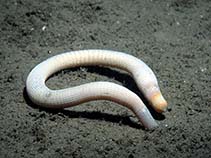
Small ones: transparent and iridescent. Large one: pinkish red. Skin is smooth to small ones. Trunk: has no papillae; introvert is covered with triangular "scales" or large white papillae directed posteriorly. Some having 4 lobes - 2 dorsal and 2 ventral. Longitudinal muscle bands (LMBs): thick strong ridges; common 5-15 cm long with 24-34 LMBs. Refractors muscles are separate and attach at the same level, each with a broad base extending over 5 - 7 longitudinal muscle bands. Spindle muscle: attached anterior to the anus. Gut: attached to the body wall by several fixing muscles or connective tissue strands throughout its length; very thin, transparent, and fragile. Nephridia: vary in length; range from 10 to 20% of the trunk length. Nephridiopores: anterior to the anus between the 4th and 5th longitudinal muscle bands. Ventral nerve cord: loosely attached anteriorly with numerous, large, lateral offshoots to the introvert (Ref. 358).
Eulittoral; intertidal and subtidal on mud, rocks, sand, silt and in rock cracks or crevices (Ref. 358 and 1784). Occurs from 12 m (Ref. 358) in the littoral zone to 2275 m (Ref. 775) along continental shelf and slope (Ref. 1456). Predated on by the finfish Diplodus sargus sargus (Ref. 41986). Inhabits shallow, subtidal sand flat. Depth: shallowest is 12 m (Ref. 358); littoral zone to 2275 m (Ref. 775, 1819); continental shelf, continental slope (Ref. 1456); intertidal zone, sandy bottoms, rock crack, eulittoral zone; mud, sand (Ref. 1784). Intertidal to 30 m, and few from 100-900 m (Ref. 1840). Burrows (Ref. 116123). A sub-surface deposit feeder (Ref. 96376). Builds a permanent burrow in the sand, obtaining food particles by moving the finer organic materials washed into the burrow (Ref. 125338).
Lebenszyklus und Paarungsverhalten
Geschlechtsreife | Fortpflanzung | Ablaichen | Eier | Fruchtbarkeit | Larven
Göthel, H. 1992 Guide de la faune sous-marine: La Méditerranée. Invertébrés marins et poissons. Eygen Ulmer GmbH & Co. 318 p. (Ref. 358)
IUCN Rote Liste Status
(Ref. 130435: Version 2025-2 (Global))
CITES Status (Ref. 108899)
Not Evaluated
Not Evaluated
Bedrohung für Menschen
Nutzung durch Menschen
FAO - Publication: search | FishSource |
Tools
Mehr Information
Trophische ÖkologieLebensmittel (Beutetiere)NahrungszusammensetzungNahrungsaufnahmeRäuber LebenszyklusFortpflanzungGeschlechtsreifeFruchtbarkeitAblaichenEierEientwicklungLarven PhysiologieSauerstoffverbrauch
MenschenbezogenBriefmarken, Münzen, Verschiedenes.
Internet Quellen
Schätzungen auf der Grundlage von Modellen
Anfälligkeit der Fischerei
(Ref. 71543) |
Low vulnerability (20 of 100). |
Preiskategorie
(Ref. 80766): |
Unknown. |