Not assigned |
Sipuncula |
Golfingiidae
Environnement : milieu / zone climatique / profondeur / gamme de distribution
Écologie
Benthic; profondeur 0 - 36 m (Réf. 1815). Temperate
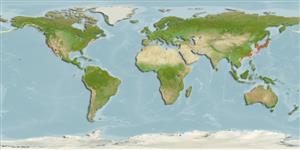
Western Central Atlantic and the Pacific Ocean: Alaska, Japan, Mexico and USA.
Longueur à la première maturité / Taille / Poids / Âge
Maturité: Lm ? range ? - ? cm
Description synthétique
Morphologie
Large animals, brownish-yellow to dark brown in color. Body 0.1-0.6 mm long. Trunk spindle shaped or cylindrical. Introvert significantly longer than trunk. Body surface smooth-seeming, as papillae covering it very small. Cephalon bearing dendritic crown of tentacles, consisting of 6 main dichotomic branching trunks. Number of orders of branching characteristic
of every particular specimen (from 4-7). Branches of tentacles bearing pinnules with
purple pigmented grains. Smooth collar behind tentacles, tentacles,
with violet patchy pigmentation. Zone of irregularly arranged large scalids behind cephalon. Longitudinal musculature of body wall not divided into longitudinal bands, instead forming solid layer. 2 retractors of introvert, both ventral and fastened into posterior third of trunk. Contractile vessel with long, filiform, spirally twisted branches braiding internal organs. Gut long, comprising 16-20 loops. 3 fixing muscles. Anal opening level with nephridiopores. Wing
muscles well-developed. No rectal diverticulum found. 2 nephridia partially fastened to body wall by mesenterial filaments. Nephridia 80% as long as trunk region (Ref. 1815).
At intertidal depths in crevices and spaces under rocks (Ref. 1840). Among rhizomes of Phyllospadix iwatensis and clusters of Modiolus modiolus kurilensis on rocky grounds (Ref. 1815). At intertidal depths from crevices in and spaces under rocks (Ref. 1840, page 152).
Cycle de vie et comportement reproducteur
Maturité | Reproduction | Frai | Œufs | Fécondité | Larves
Morozov, T.B. and A.V. Adrianov 2002 Fauna of Sipunculans (Sipuncula) of Vostok Bay, Sea of Japan. Russian Journal of Marine Biology 28(6):365-370. (Réf. 1815)
Statut dans la liste rouge de l'IUCN
(Réf. 130435: Version 2025-2 (Global))
statut CITES (Réf. 108899)
Not Evaluated
Not Evaluated
Menace pour l'homme
Utilisations par l'homme
FAO - Publication: search | FishSource |
Outils
Plus d'informations
Écologie trophiqueAliments (proies)
Composition du régime alimentaire
Consommation alimentaire
Prédateurs
Dynamique des populationsCroissanceÂges / tailles maximalesLongueur-poids rel.Rel. longueur-longueur.Fréquences de longueursConversion de masseAbondance Cycle de vieReproductionMaturitéFéconditéFraiŒufsDéveloppement de l'œufLarves PhysiologieConsommation d'oxygène
Liées à l'hommeTimbres, pièces de monnaie, divers
Sources Internet
Estimations basées sur des modèles
Vulnérabilité de la pêche
(Réf. 71543) |
(0 of 100). |
Catégorie de prix
(Réf. 80766): |
Unknown. |