Not assigned |
Pedicellinida |
Pedicellinidae
Environnement : milieu / zone climatique / profondeur / gamme de distribution
Écologie
Benthic; profondeur 9 - 52 m (Réf. 1442). Temperate
Northeast Atlantic: from Denmark to UK.
Longueur à la première maturité / Taille / Poids / Âge
Maturité: Lm ? range ? - ? cm Max length : 0.0 cm BL mâle / non sexé; (Réf. 3192)
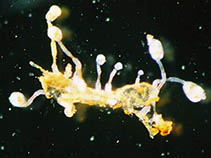
Found on ventral side of Aphrodida aculeata, on upper surface of elytrae of Lepidonotus squamatus, on shells inhabited by Phascolion and several other invertebrates (Ref. 429). Depth range from Isles of Scilly record (Ref. 1442); to be replaced with a better reference. Cosmopolitan (Ref. 429). Feeds on detritus and protists (Ref. 95814).
Cycle de vie et comportement reproducteur
Maturité | Reproduction | Frai | Œufs | Fécondité | Larves
Hansson, H.G. 1998 NEAT (North East Atlantic Taxa): South Scandinavian marine "Aschelminth" (except Nematoda, which are treated separately and some other species poor phyla Check-List. Internet pdf Ed., http://www.tmbl.gu.se (Réf. 429)
Statut dans la liste rouge de l'IUCN
(Réf. 130435: Version 2025-2 (Global))
statut CITES (Réf. 108899)
Not Evaluated
Not Evaluated
Menace pour l'homme
Utilisations par l'homme
FAO - Publication: search | FishSource |
Outils
Plus d'informations
Écologie trophiqueAliments (proies)
Composition du régime alimentaire
Consommation alimentaire
Prédateurs
Dynamique des populationsCroissance
Âges / tailles maximales
Longueur-poids rel.
Rel. longueur-longueur.
Fréquences de longueurs
Conversion de masse
Abondance
Cycle de vieReproductionMaturitéFéconditéFraiŒufsDéveloppement de l'œufLarves PhysiologieConsommation d'oxygène
Liées à l'hommeTimbres, pièces de monnaie, divers
Sources Internet
Estimations basées sur des modèles
Vulnérabilité de la pêche
(Réf. 71543) |
Low vulnerability (10 of 100). |
Catégorie de prix
(Réf. 80766): |
Unknown. |