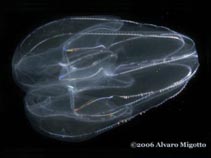
Tentaculata |
Lobata |
Bolinopsidae
Environnement : milieu / zone climatique / profondeur / gamme de distribution
Écologie
Pélagique; saumâtre. Subtropical
Indo-West Pacific, Western Atlantic and the Mediterranean.
Longueur à la première maturité / Taille / Poids / Âge
Maturité: Lm ? range ? - ? cm Max length : 8.0 cm H mâle / non sexé; (Réf. 1610)
Found in a mangrove vegetate area (Ref. 121475).
Cycle de vie et comportement reproducteur
Maturité | Reproduction | Frai | Œufs | Fécondité | Larves
Members of the phylum Ctenophora are hermaphroditic. Life cycle: Eggs develop into planktonic juveniles called cydippid and later gradually adopt the form of adults.
Bigelow, H.B. 1912 Ctenophores of the Atlantic coasts of the North America. Science (New Series) 36(921):243-244. (Réf. 1588)
Statut dans la liste rouge de l'IUCN
(Réf. 130435: Version 2025-2 (Global))
statut CITES (Réf. 108899)
Not Evaluated
Not Evaluated
Menace pour l'homme
Utilisations par l'homme
FAO - Publication: search | FishSource |
Outils
Plus d'informations
Écologie trophiqueAliments (proies)
Composition du régime alimentaire
Consommation alimentaire
Prédateurs
Dynamique des populations Cycle de vieReproductionMaturitéFéconditéFraiŒufsDéveloppement de l'œufLarves PhysiologieConsommation d'oxygène
Liées à l'hommeTimbres, pièces de monnaie, divers
Sources Internet
Estimations basées sur des modèles
Vulnérabilité de la pêche
(Réf. 71543) |
Low vulnerability (10 of 100). |
Catégorie de prix
(Réf. 80766): |
Unknown. |