Tentaculata |
Lobata |
Bolinopsidae
Umwelt: Milieu / Klimazone / Tiefenbereich / Verbreitungsgebiet
Ökologie
Pelagisch; tiefenbereich 5 - 200 m (Ref. 1531). Subtropical; ? - 32°C (Ref. 138208); 41°N - 47°S, 98°W - 31°W
Western Atlantic: from Buzzard Bay, USA to Gulf of Mexico, Caribbean, south to Argentina.
Länge bei der ersten Reifung / Größe / Gewicht / Alter
Geschlechtsreife: Lm ? range ? - ? cm Max length : 18.0 cm TL Männchen/unbestimmt; (Ref. 114265); common length : 1.0 cm TL Männchen/unbestimmt; (Ref. 3033); max. veröff. Gewicht: 0.97 g (Ref. 3033)
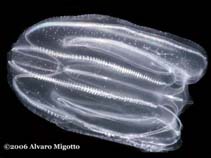
Polymorphic species, with Baltic Sea individuals smaller and adults do not have very long oral lobes unlike the Black Sea individuals (Ref. 2959). Inner structures of the lobes originate at the level of the apical organ near the top of the organism. Has eight meridianal canals (Ref. 2956). Confused with the dominant ctenophore in the North Sea, Bolinopsis infundibulum due to their similarities in appearance.
Found in marine and brackish waters (Ref. 770). Found in the intertidal, bay and nearshore, outer continental shelf and slope (Ref. 116106). A carnivorous hunter which feeds on zooplankton, including meroplankton, fish eggs and fish larvae (Ref. 2969). Known to tolerate a wide range of salinity (3.4 to 75.0 parts per mile) and temperature (1.3 to 32°C) from its native range in the American region.
Lebenszyklus und Paarungsverhalten
Geschlechtsreife | Fortpflanzung | Ablaichen | Eier | Fruchtbarkeit | Larven
A simultaneous hermaphrodite with direct development. Sexual reproduction begins at 3 cm length for U.S. waters species and 1 cm oral-aboral length for Black Sea species. Larvae is spherical (cydippid) and hatch in 20 to 24 hours. Develops from tentaculate to lobate feeding mechanism as it matures. Egg production is sensitive to ctenophore size, food availability and temperature. In Chesapeake Bay, USA, egg production occurred at temperatures 11.8 to 29 °C and salinities 5.6 to 29.8 parts per mille. Weight-specific egg production was greater in summer due to higher temperature, salinity and prey density than in spring. Spawning in this area peaks between 2:00 and 4:00 h. In the Black Sea, spawning begins at midnight to 2:00 h. No spawning in spring at 8 to 16 °C, intensive spawning in late summer to autumn at temperature 23 °C.
Mutlu, E. 1999 Distribution and abundance of ctenophores and their zooplankton food in theBlack Sea. II. Mnemiopsis leidyi. Mar. Biol. 135:603-613. (Ref. 1531)
IUCN Rote Liste Status
(Ref. 130435: Version 2025-2 (Global))
CITES Status (Ref. 108899)
Not Evaluated
Not Evaluated
Bedrohung für Menschen
Nutzung durch Menschen
FAO - Publication: search | FishSource |
Tools
Mehr Information
PhysiologieSauerstoffverbrauch
MenschenbezogenBriefmarken, Münzen, Verschiedenes.
Internet Quellen
Schätzungen auf der Grundlage von Modellen
Anfälligkeit der Fischerei
(Ref. 71543) |
Low vulnerability (10 of 100). |
Preiskategorie
(Ref. 80766): |
Unknown. |