Gastropoda |
Not assigned |
Acteonidae
Umwelt: Milieu / Klimazone / Tiefenbereich / Verbreitungsgebiet
Ökologie
Benthic. Temperate
Northeast Atlantic and the Mediterranean: Celtic and Lusitanian provinces.
Länge bei der ersten Reifung / Größe / Gewicht / Alter
Geschlechtsreife: Lm ? range ? - ? cmCommon length : 0.6 cm SHL Männchen/unbestimmt; (Ref. 360)
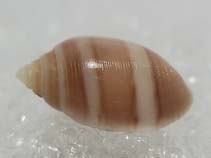
Shell: quite thick, fairly short, conical spire with slightly convex whorls, impressed suture, elongated oval in shape; first turns of the shell are heterostrophe (i.e., the axis of coiling forms an angle to the adult shell's columella; very elongated oval aperture, with a thin and sharp outer lip, columellar lip has a light callus and a deep fold at the base; sculpture consists of thin spiral grooves more marked toward the posterior and anterior edges of the whorls; pink hazel in color, with one or two whitish spiral bands; operculum is horny, pale yellow and transparent. Body: very wide foot, differentiated anteriorly into a podium; head broadens into a cephalic disc which has two lateroposterior lobes, incorrectly called tentacles; eyes are sessile; gill, osphradium and penis are inside the mantle cavity; radula lacks rachidial teeth and has a very large number of lateral teeth.
Inhabits fine well sorted sand (Ref. 2780). Free-living (Ref. 3123).
Lebenszyklus und Paarungsverhalten
Geschlechtsreife | Fortpflanzung | Ablaichen | Eier | Fruchtbarkeit | Larven
Hermaphrodite.
Harms, J. 1993 Check list of species (algae, invertebrates and vertebrates) found in the vicinity of the island of Helgoland (North Sea, German Bight) - a review of recent records. Helgoländer Meeresunters 47:1-34. (Ref. 2711)
IUCN Rote Liste Status
(Ref. 130435: Version 2025-2 (Global))
CITES Status (Ref. 108899)
Not Evaluated
Not Evaluated
Bedrohung für Menschen
Nutzung durch Menschen
FAO - Publication: search | FishSource |
Tools
Mehr Information
Trophische ÖkologieLebensmittel (Beutetiere)
Nahrungszusammensetzung
Nahrungsaufnahme
Räuber
PopulationsdynamikWachstum
Max. Alter/Größen
Länge-Gewicht-Rel.
Länge-Länge-Verhältnis.
Längenhäufigkeiten
Massenkonvertierung
Dichte
LebenszyklusFortpflanzungGeschlechtsreifeFruchtbarkeitAblaichenEierEientwicklungLarven PhysiologieSauerstoffverbrauch
MenschenbezogenBriefmarken, Münzen, Verschiedenes.
Internet Quellen
Schätzungen auf der Grundlage von Modellen
Anfälligkeit der Fischerei
(Ref. 71543) |
(0 of 100). |
Preiskategorie
(Ref. 80766): |
Unknown. |