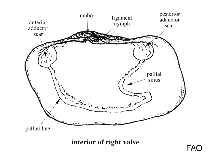
Bivalvia |
Adapedonta |
Hiatellidae
Environnement : milieu / zone climatique / profondeur / gamme de distribution
Écologie
Benthic. Subtropical
Northwest Pacific: Korea Republic, China and Japan.
Longueur à la première maturité / Taille / Poids / Âge
Maturité: Lm ? range ? - ? cm Max length : 16.0 cm SHL mâle / non sexé; (Réf. 128019); poids max. publié: 800.00 g (Réf. 128019)
Found in shallow water and fine sand (Ref. 75831). Found in shallow water and fine sand (Ref. 53).
Cycle de vie et comportement reproducteur
Maturité | Reproduction | Frai | Œufs | Fécondité | Larves
Members of the class Bivalvia are mostly gonochoric, some are protandric hermaphrodites. Life cycle: Embryos develop into free-swimming trocophore larvae, succeeded by the bivalve veliger, resembling a miniature clam.
Beu, A. and A. Kitamura 1998 Exposed coasts vs. sheltered bays: contrast between New Zealand and Japan in the molluscan record of temperature change in Plio-Pleistocene cyclothems. Sedimentary Geology 122:129-149. (Réf. 77625)
Statut dans la liste rouge de l'IUCN
(Réf. 130435: Version 2025-2 (Global))
statut CITES (Réf. 108899)
Not Evaluated
Not Evaluated
Menace pour l'homme
Utilisations par l'homme
Pêcheries: commercial
FAO - Publication: search | FishSource |
Outils
Plus d'informations
Écologie trophiqueAliments (proies)
Composition du régime alimentaire
Consommation alimentaire
Prédateurs
Dynamique des populations PhysiologieConsommation d'oxygène
Liées à l'hommeTimbres, pièces de monnaie, divers
Sources Internet
Estimations basées sur des modèles
Vulnérabilité de la pêche
(Réf. 71543) |
Low vulnerability (10 of 100). |